Blog
Retatrutide Peptide: Triple-Receptor Mechanisms & Research Guide [2026]

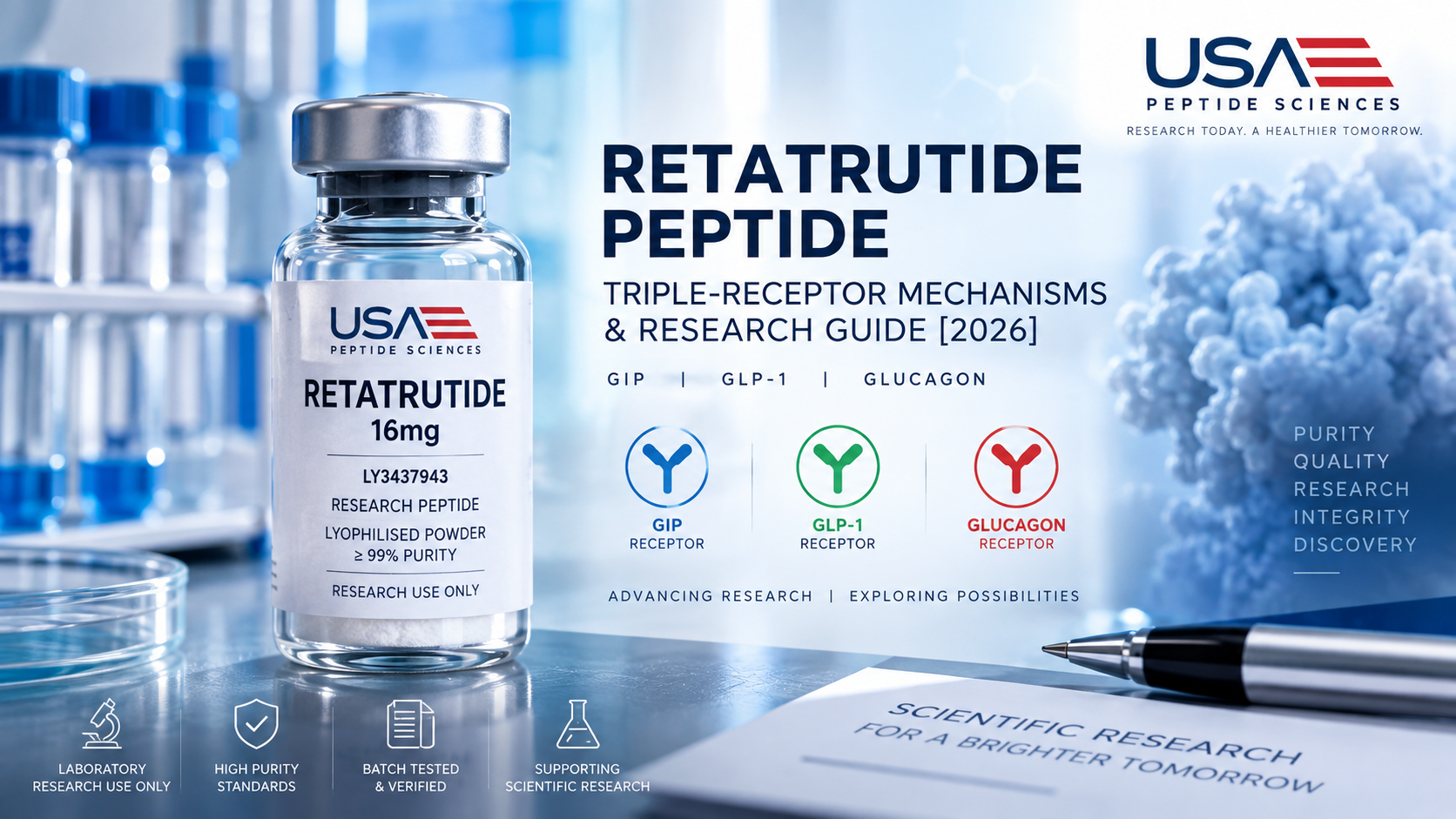
Retatrutide peptide, also known by the research designation LY3437943, has become one of the most closely studied multi-receptor peptides in metabolic research. Unlike compounds designed primarily around a single receptor pathway, retatrutide was engineered to interact with three distinct signaling systems: the glucose-dependent insulinotropic polypeptide receptor (GIPR), glucagon-like peptide-1 receptor (GLP-1R), and glucagon receptor (GCGR).
This triple-receptor architecture makes retatrutide peptide particularly interesting from a research perspective. Rather than investigating a single incretin pathway in isolation, laboratory and clinical research can examine how simultaneous activation of three metabolically relevant receptors changes downstream signaling, energy regulation, glucose-associated pathways, and receptor cross-talk.
USA Peptide Sciences supplies Retatrutide 16mg research material strictly for qualified laboratory and scientific research.
What Is Retatrutide Peptide?
Retatrutide peptide is a synthetic peptide originally identified as LY3437943 and developed as a multi-receptor agonist.
Published research describes the compound as having agonist activity at three receptors:
GIPR — glucose-dependent insulinotropic polypeptide receptor
GLP-1R — glucagon-like peptide-1 receptor
GCGR — glucagon receptor
Early characterization published in Cell Metabolism demonstrated that LY3437943 could activate all three receptor systems rather than functioning as a conventional single-receptor GLP-1 agonist. The researchers reported relatively balanced activity at the glucagon and GLP-1 receptors, with greater activity at the GIP receptor.
Researchers can review the original LY3437943 discovery and proof-of-concept study on PubMed.
This multi-receptor architecture is the defining feature of retatrutide peptide research.
Retatrutide Mechanism of Action in Research Models
Understanding retatrutide peptide requires looking at the three receptor systems separately before considering how they operate together.
GLP-1 Receptor Signaling
GLP-1R is a G-protein-coupled receptor involved in glucose-dependent insulin signaling, gastrointestinal signaling, appetite-related pathways, and broader metabolic regulation.
GLP-1 receptor agonism is already extensively characterized across experimental models. With retatrutide peptide, however, GLP-1R activation forms only one part of a larger signaling network.
The compound therefore provides researchers with an opportunity to examine GLP-1-associated signaling while GIPR and GCGR are being activated by the same molecular platform.
GIP Receptor Signaling
GIPR is another incretin-associated receptor involved in glucose-dependent endocrine signaling and metabolic regulation.
Published characterization of retatrutide found comparatively strong GIP receptor activity, making GIPR an important component of the compound’s pharmacological profile.
The simultaneous presence of GIP and GLP-1 receptor activity allows researchers to investigate signaling relationships that cannot be reproduced by a single-receptor experimental compound.
Glucagon Receptor Signaling
The third component distinguishes retatrutide peptide from both single GLP-1 agonists and dual GIP/GLP-1 agonists.
Activation of the glucagon receptor has been investigated in connection with hepatic metabolism, substrate utilization, energy expenditure, and glucose regulation.
Preclinical research into LY3437943 suggested that adding GCGR activity to GIPR and GLP-1R agonism altered metabolic outcomes compared with incretin receptor signaling alone.
The exact contribution of glucagon receptor activation remains an active area of research rather than a completely resolved mechanism.
Why Triple-Receptor Agonism Matters
The scientific interest surrounding retatrutide peptide is not simply that it activates three receptors. The more important question is whether signaling through those receptors simultaneously creates biological effects that differ from activating each pathway independently.
This concept is sometimes referred to as multi-agonism or polyagonism.
Instead of combining three unrelated compounds, one molecular structure is engineered with affinity for several receptors.
This offers several experimental questions.
Researchers can study receptor selectivity, relative potency, downstream second-messenger signaling, receptor cross-talk, metabolic pathway interactions, and the contribution of individual receptors to an observed experimental outcome.
Structural research has gone even further. Cryogenic electron microscopy studies have examined retatrutide bound separately to GLP-1R, GIPR, and GCGR, providing molecular-level information about how one peptide sequence can interact with all three receptor architectures.
The structural study of retatrutide binding to GLP-1R, GIPR and GCGR provides useful primary evidence for researchers studying the molecular basis of triple agonism.
What Published Retatrutide Research Has Examined
Retatrutide peptide has progressed through several levels of investigation, ranging from receptor characterization and animal models to controlled clinical research.
Initial work focused heavily on receptor pharmacology, pharmacokinetics, metabolic signaling, and preclinical models.
Subsequent phase 2 investigations examined retatrutide in people with obesity and in participants with type 2 diabetes. These studies reported dose-dependent metabolic effects while also documenting adverse events, particularly gastrointestinal events at some doses.
Those human studies are relevant to understanding the compound’s research history, but they should not be interpreted as authorization for unsupervised use.
As of September 2026, retatrutide remains investigational and has not been approved by a regulatory agency. Eli Lilly has reported Phase 3 topline results during 2026, while emphasizing that the investigational compound has not received regulatory approval.
For laboratory suppliers, this distinction is especially important. Research-grade retatrutide and pharmaceutical products are not interchangeable categories.
Retatrutide Peptide Compared With Single and Dual Receptor Research
A useful way to understand retatrutide peptide is by comparing receptor architecture rather than making therapeutic comparisons.
Semaglutide is primarily designed around GLP-1 receptor agonism.
Dual-agonist compounds can combine GIPR and GLP-1R activity.
Retatrutide adds glucagon receptor activity to those two incretin pathways, creating the GLP-1R/GIPR/GCGR triple-agonist configuration.
Researchers interested specifically in GLP-1 signaling can also review the USA Peptide Sciences Semaglutide 10mg research peptide listing for a single-receptor research comparison.
The important experimental difference is therefore not simply potency. It is receptor architecture.
Retatrutide 16mg Research Specifications
The USA Peptide Sciences research configuration is supplied as Retatrutide 16mg in lyophilized form.
The product is categorized within the site’s metabolic and weight-associated research inventory and is intended strictly for laboratory research use.
Researchers requiring broader access to related experimental compounds can review the USA Peptide Sciences research peptide catalog, which currently contains approximately 160 research products across multiple research categories.
Specifications and analytical documentation should always be verified against the current product listing and current batch Certificate of Analysis rather than copied from older third-party databases.
Why Analytical Verification Matters for Retatrutide Research
Complex research peptides require more than a stated purity percentage.
High-performance liquid chromatography can provide information about relative sample purity, while mass spectrometry can provide molecular identity information based on mass characteristics.
For this reason, researchers evaluating retatrutide peptide material should look beyond marketing statements such as “high purity.”
Batch documentation should allow the laboratory to determine what analytical method was used, which batch was tested, whether molecular identity was evaluated, and whether the documentation actually corresponds to the material being supplied.
USA Peptide Sciences publishes its broader testing and documentation approach through its Quality Assurance documentation.
This same issue was discussed in our guide to evaluating a Peptide Science alternative and research supplier, where batch-specific analytical documentation is treated as one of the primary sourcing standards.
Sourcing Retatrutide Peptide for Laboratory Research
Researchers sourcing experimental peptides should evaluate documentation before focusing on price or concentration.
The supplier should clearly identify the material, research quantity, analytical testing methodology, batch documentation, intended research-only classification, and manufacturing or sourcing information.
For an investigational compound such as retatrutide, maintaining the distinction between legitimate laboratory research material and an approved pharmaceutical product is especially important.
USA Peptide Sciences offers research materials exclusively for laboratory and scientific investigation and does not position retatrutide peptide as an approved medication or consumer product.
Frequently Asked Questions About Retatrutide Peptide
What is retatrutide peptide?
Retatrutide peptide, also known as LY3437943, is a synthetic multi-receptor agonist studied for activity at the GIP, GLP-1, and glucagon receptors. Its triple-receptor architecture makes it an important experimental compound in multi-agonist and metabolic signaling research.
Is retatrutide a GLP-1 peptide?
Retatrutide has GLP-1 receptor agonist activity, but describing it only as a GLP-1 compound is incomplete. Published research demonstrates agonist activity at GLP-1R, GIPR, and GCGR.
What makes retatrutide different from semaglutide?
The primary research distinction is receptor architecture. Semaglutide primarily targets GLP-1R, while retatrutide peptide has documented agonist activity at GLP-1R, GIPR, and GCGR.
What is LY3437943?
LY3437943 is the research development designation for retatrutide. Scientific publications examining the peptide’s discovery, receptor pharmacology, and early development frequently use the LY3437943 identifier.
Has retatrutide been studied in humans?
Yes. Controlled clinical studies have investigated retatrutide, including phase 2 studies in metabolic research populations, and Phase 3 studies have subsequently been conducted. This does not make research-grade retatrutide an approved pharmaceutical product.
Is retatrutide FDA approved?
No. As of September 2026, retatrutide remains investigational and has not been approved by the FDA or another regulatory agency.
Why is HPLC-MS important for retatrutide research material?
Chromatographic purity and molecular identity answer different analytical questions. Researchers should therefore review the actual batch documentation and analytical methodology rather than relying solely on a stated purity percentage.
Where can researchers find retatrutide peptide?
USA Peptide Sciences provides Retatrutide 16mg as research material for qualified laboratory investigation only. Researchers should review the current product documentation and batch-specific analytical information before incorporating any research compound into an experimental workflow.
Research Use Disclaimer
This article is provided solely for educational, scientific, and laboratory research purposes.
Retatrutide peptide and LY3437943 discussed on this page are not presented as approved pharmaceutical products. Research compounds supplied by USA Peptide Sciences are intended strictly for controlled laboratory and scientific investigation and are not intended for human or veterinary consumption, therapeutic use, diagnosis, treatment, or medical administration.
References to published clinical research are included to describe the scientific literature and development history of the compound. They do not constitute medical advice, dosage guidance, treatment recommendations, or claims of therapeutic efficacy.
All laboratory handling and experimental evaluation should be performed by appropriately qualified research professionals.