Blog
5-Amino-1MQ: NNMT Mechanism, Research & Sourcing Guide [2026]

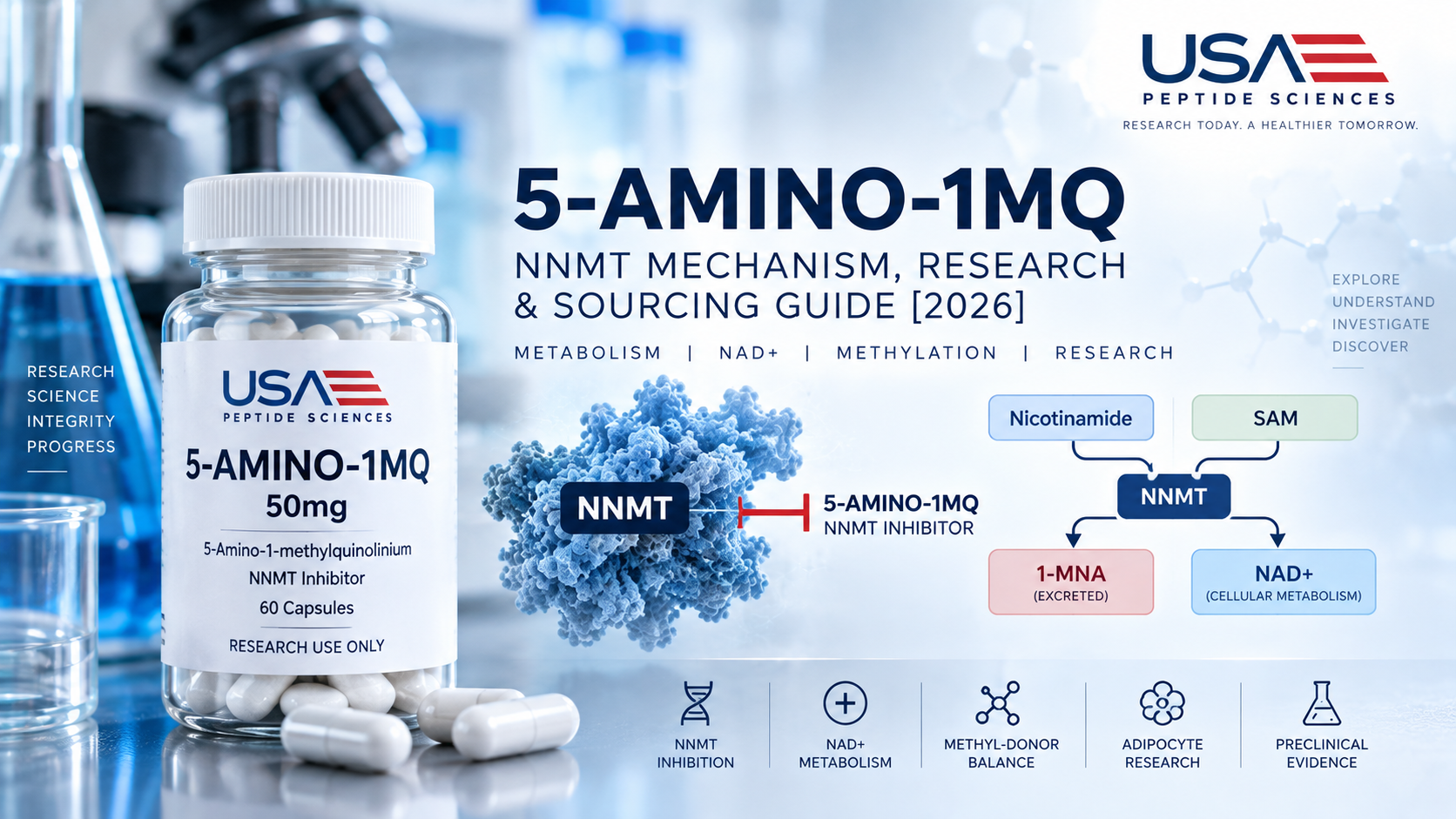
5-amino-1mq is a small-molecule research compound developed as an inhibitor of nicotinamide N-methyltransferase, commonly abbreviated NNMT. Interest in the compound has grown because NNMT sits at an important intersection between nicotinamide metabolism, NAD+ availability, methyl-donor balance, adipocyte biology, and cellular energy regulation.
Unlike many compounds in the USA Peptide Sciences catalogue, 5-amino-1mq is not a peptide. It is a membrane-permeable synthetic small molecule that researchers use as a biochemical probe for investigating NNMT-dependent pathways.
Published research remains primarily preclinical. Studies have examined the compound in cultured adipocytes and diet-induced obesity mouse models, where investigators evaluated NNMT inhibition, intracellular 1-methylnicotinamide levels, NAD+ and S-adenosylmethionine availability, lipid accumulation, body composition, glucose regulation, and tissue distribution.
USA Peptide Sciences supplies 5-Amino-1MQ 50mg research capsules in a 60-capsule laboratory research configuration.
What Is 5-Amino-1MQ?
5-amino-1mq is the commonly used abbreviation for 5-amino-1-methylquinolinium, a synthetic inhibitor developed to target NNMT.
NNMT is a cytosolic enzyme that transfers a methyl group from S-adenosylmethionine, or SAM, to nicotinamide. This reaction produces 1-methylnicotinamide, commonly abbreviated 1-MNA.
That reaction matters because nicotinamide participates in the NAD+ salvage pathway, while SAM is one of the major methyl donors used throughout cellular biochemistry.
By inhibiting NNMT, researchers can investigate what happens when less nicotinamide is diverted toward 1-MNA production and when the cellular balance of NAD+- and methyl-donor-associated metabolites changes.
Early biochemical characterization identified 5-amino-1mq as a selective, cell-permeable NNMT inhibitor suitable for investigating these processes in cultured cells and animal models.
How 5-Amino-1MQ Works in Research Models
NNMT Inhibition
The central mechanism of 5-amino-1mq research is inhibition of nicotinamide N-methyltransferase.
Under normal conditions, NNMT uses SAM to methylate nicotinamide, creating 1-MNA.
Researchers therefore use intracellular 1-MNA concentrations as one experimental indicator of NNMT activity.
In published adipocyte experiments, exposure to the compound significantly reduced intracellular 1-MNA concentrations in both pre-adipocytes and differentiated adipocytes. The researchers interpreted this as evidence of effective intracellular NNMT inhibition.
This provides an important distinction between simply demonstrating that a molecule inhibits an isolated enzyme and demonstrating activity inside living cells.
NAD+ Metabolism
Nicotinamide is an important precursor in the NAD+ salvage pathway.
Because NNMT diverts nicotinamide toward formation of 1-MNA, researchers have investigated whether NNMT inhibition can alter the intracellular availability of nicotinamide for NAD+ metabolism.
In cultured adipocytes, researchers reported concentration-dependent increases in intracellular NAD+ after treatment with 5-amino-1mq. Significant changes were observed at selected experimental concentrations.
NAD+ is involved in numerous cellular processes including redox reactions, mitochondrial energy metabolism, DNA repair-associated signaling, and the activity of NAD+-dependent enzymes.
However, an important distinction should be maintained: demonstrating increased NAD+ in a cultured-cell experiment does not establish broad claims about longevity, energy, or therapeutic effects in humans.
The appropriate interpretation is that NNMT inhibition appears capable of altering nicotinamide/NAD+ metabolism under specific experimental conditions.
SAM and Cellular Methyl-Donor Balance
NNMT also consumes SAM during the methylation of nicotinamide.
Researchers have therefore studied whether inhibiting NNMT changes intracellular SAM concentrations.
The original experimental work reported increased SAM levels in adipocytes at higher tested concentrations of 5-amino-1mq.
This finding helped expand interest in NNMT beyond simple nicotinamide metabolism.
Because SAM participates in numerous methylation reactions, NNMT has increasingly been studied as part of the relationship between metabolism and epigenetic regulation.
This does not mean that 5-amino-1mq should automatically be described as an “epigenetic therapy.” Rather, it provides a research tool for examining how NNMT activity influences the pool of metabolites involved in methylation-dependent cellular processes.
5-Amino-1MQ and Adipocyte Research
One of the best-known areas of 5-amino-1mq research involves adipocyte biology.
In 3T3-L1 cell models, researchers examined lipid accumulation during differentiation of pre-adipocytes into mature adipocytes.
Treatment with the NNMT inhibitor produced concentration-dependent reductions in lipid accumulation in those experimental models. The study reported substantial inhibition of lipogenesis at higher experimental concentrations while assessing cell viability separately.
This is important because it gives researchers a way to examine whether NNMT contributes to adipocyte differentiation and lipid-storage pathways.
It does not establish that the compound is an approved weight-management agent.
Cell-culture findings describe what occurred in a controlled experimental model and should not be extrapolated directly into claims about people.
What Animal Studies Have Found
Researchers subsequently studied NNMT inhibition in diet-induced obesity models.
In the original proof-of-concept mouse study, administration of 5-amino-1mq was associated with reductions in body weight and adipose tissue measurements relative to control animals. Researchers also examined adipocyte size, plasma cholesterol, food intake, and related metabolic endpoints.
A later study expanded this work using a longer diet-induced obesity model.
That research examined body composition, glucose tolerance, insulin sensitivity, circulating biomarkers, liver pathology, pharmacokinetics, and tissue distribution.
The investigators reported that 5A1MQ treatment limited body-weight and fat-mass gain in a dose-dependent manner in the mouse model. They also reported changes in glucose tolerance, insulin sensitivity, hyperinsulinemia, hepatic triglycerides, steatosis, and inflammatory-cell infiltration in liver tissue.
The study also characterized the compound after intravenous, oral, and subcutaneous administration in animals, providing additional pharmacokinetic information about experimental exposure and tissue distribution.
Researchers can review the published 5A1MQ metabolic study indexed by PubMed for the full experimental methodology and results.
Why NNMT Is an Important Research Target
NNMT is increasingly studied because its activity connects several major biochemical systems.
These include:
- nicotinamide metabolism
- NAD+ salvage pathways
- SAM-dependent methyl metabolism
- adipocyte differentiation
- lipid accumulation
- glucose-associated metabolic signaling
- hepatic metabolic pathways
- cellular energy homeostasis
A review of NNMT research in metabolic disease describes the enzyme as an important regulator of energy metabolism and summarizes experimental work involving 5-amino-1mq and other NNMT inhibitors.
Researchers interested in the broader pathway can review this peer-reviewed overview of NNMT in metabolic research.
The growing interest in NNMT does not mean every proposed downstream effect has been established.
It means NNMT provides a useful experimental target through which scientists can study the relationships among nicotinamide metabolism, methylation chemistry, adipocyte biology, and metabolic homeostasis.
5-Amino-1MQ Is a Small Molecule — Not a Peptide
This distinction is particularly important for researchers comparing compounds.
5-amino-1mq is sometimes discussed alongside peptides because research suppliers may place it in the same broader catalogue.
Chemically, however, it is not composed of an amino-acid peptide chain.
It is a small-molecule NNMT inhibitor.
That distinction affects how researchers think about molecular size, membrane permeability, analytical characterization, degradation pathways, and experimental delivery.
USA Peptide Sciences currently lists the compound in its Peptide Capsules research category, but the product description correctly identifies it as a synthetic small molecule rather than a peptide.
What Published Research Does Not Yet Establish
Good research content should distinguish evidence from extrapolation.
Current published evidence on 5-amino-1mq is heavily weighted toward biochemical assays, cultured cells, and animal models.
The available studies discussed above do not establish that laboratory-grade 5-amino-1mq products are approved treatments for obesity, diabetes, metabolic disease, aging, or any other human condition.
Mouse-model changes in body composition or glucose-associated endpoints should not be rewritten as guaranteed effects in people.
Similarly, increases in intracellular NAD+ in adipocytes do not demonstrate a clinical “anti-aging” effect.
The strongest scientifically accurate description is that researchers are investigating NNMT inhibition as a metabolic mechanism and that 5-amino-1mq is one experimental small molecule used to study that target.
5-Amino-1MQ Research Specifications
The current USA Peptide Sciences research configuration includes:
- Compound: 5-Amino-1-methylquinolinium
- Common abbreviation: 5-Amino-1MQ / 5A1MQ
- Compound class: Small-molecule NNMT inhibitor
- Research format: Encapsulated material
- Quantity: 50mg per capsule
- Bottle configuration: 60 capsules
- Primary research target: Nicotinamide N-methyltransferase
- Research classification: Laboratory research compound only
The current product page describes the material as a high-purity synthetic small molecule intended for investigations involving NNMT, cellular metabolism, and related biochemical pathways.
Researchers should verify batch-specific technical specifications against the current product documentation rather than relying on third-party databases or specifications copied from unrelated suppliers.
Analytical Verification of 5-Amino-1MQ Research Material
Scientific research depends on knowing both the identity and quality of the material being investigated.
A purity number alone does not answer every analytical question.
Chromatographic methods such as HPLC can help evaluate purity and detect additional components in a sample, while mass spectrometric methods can provide evidence relating to molecular identity.
For small-molecule research compounds, researchers should examine the actual analytical documentation for the batch rather than relying only on website marketing language.
USA Peptide Sciences describes a quality framework incorporating incoming verification, batch consistency review, third-party testing for eligible materials, HPLC assessment, mass-spectrometry verification where applicable, and batch documentation.
Researchers can review the USA Peptide Sciences Quality Assurance standards before selecting research materials.
Sourcing Standards for 5-Amino-1MQ Research
Because research compounds sold online can vary substantially in documentation and quality control, researchers should evaluate suppliers using objective standards.
1. Confirm Compound Identity
Documentation should identify the actual compound rather than simply using a popular product name.
For 5-amino-1mq, the documentation should make clear that the material is an NNMT-targeting small molecule.
2. Review Batch-Specific Analytical Documentation
A generic certificate reused across unrelated production lots provides limited information about the specific material being purchased.
Researchers should look for batch or lot identifiers and analytical documentation corresponding to the supplied material.
3. Evaluate the Analytical Methods
Purity and identity are separate questions.
Researchers should determine which analytical techniques were used and what each reported result actually demonstrates.
4. Verify the Research Format
Capsule count, quantity per capsule, compound identity, and intended experimental configuration should be clearly stated.
USA Peptide Sciences currently supplies 5-Amino-1MQ 50mg capsules for laboratory research in a 60-capsule configuration.
5. Avoid Unsupported Human Claims
A research supplier should distinguish published cell and animal evidence from demonstrated clinical outcomes.
Claims should not turn preclinical NNMT findings into promises about weight loss, disease treatment, longevity, or other human outcomes.
Researchers comparing related compounds can also browse the broader USA Peptide Sciences research compound catalogue.
Frequently Asked Questions About 5-Amino-1MQ
What is 5-Amino-1MQ?
5-amino-1mq is a synthetic small-molecule inhibitor of nicotinamide N-methyltransferase, or NNMT. Researchers study it to examine how NNMT inhibition affects nicotinamide metabolism, 1-MNA formation, NAD+ availability, methyl-donor balance, adipocyte biology, and related metabolic pathways.
Is 5-Amino-1MQ a peptide?
No.
Despite sometimes appearing in peptide-supplier catalogues, 5-amino-1mq is not a peptide. It is a small molecule commonly referred to chemically as 5-amino-1-methylquinolinium.
What enzyme does 5-Amino-1MQ inhibit?
Its principal research target is nicotinamide N-methyltransferase.
NNMT catalyzes methylation of nicotinamide using SAM as a methyl donor, producing 1-methylnicotinamide.
What has published research found?
Published experiments have reported reductions in intracellular 1-MNA, changes in NAD+ and SAM concentrations, reduced lipid accumulation in adipocyte models, and metabolic changes in diet-induced obesity mouse models. These findings remain preclinical.
Does 5-Amino-1MQ increase NAD+?
Published cultured-adipocyte experiments reported concentration-dependent increases in intracellular NAD+ after NNMT inhibition with the compound. That finding describes a specific cellular research model and should not be interpreted as proof of a clinical effect in humans.
Has 5-Amino-1MQ been studied orally?
Animal pharmacokinetic research has evaluated 5A1MQ after multiple routes of administration, including oral administration, as part of studies examining plasma pharmacokinetics and tissue distribution.
This should not be confused with evidence establishing a consumer dosage or approved human-use protocol.
Is 5-Amino-1MQ approved for human weight loss?
The research discussed in this article is preclinical and does not establish laboratory-grade 5-amino-1mq as an approved human weight-loss treatment.
USA Peptide Sciences supplies the compound strictly as research material.
What should researchers look for when sourcing 5-Amino-1MQ?
Researchers should prioritize verified compound identity, batch-specific documentation, appropriate analytical testing, clear concentration and format information, transparent research-use restrictions, and evidence-based product descriptions.
Conclusion
5-amino-1mq has become an important experimental compound in NNMT research because it allows investigators to probe a metabolic enzyme positioned between nicotinamide utilization, NAD+ availability, methyl-donor metabolism, lipid biology, and cellular energy regulation.
Published studies provide evidence that inhibiting NNMT with this small molecule can alter 1-MNA, NAD+, SAM, lipid accumulation, and metabolic endpoints in cellular and animal models.
At the same time, responsible interpretation requires maintaining the boundary between those preclinical findings and claims about human outcomes.
For laboratories investigating NNMT-associated pathways, USA Peptide Sciences provides 5-Amino-1MQ 50mg research capsules alongside a wider catalogue of laboratory research compounds and published quality-assurance standards.
Research Use Disclaimer
This article is provided solely for informational, educational, and laboratory research purposes.
5-Amino-1MQ and all related research compounds referenced in this article are not presented as approved medicines, dietary supplements, therapeutic agents, or products for human or veterinary consumption.
All mechanisms and experimental outcomes discussed above refer to published biochemical, in-vitro, cellular, or preclinical animal research unless explicitly stated otherwise.
References to body composition, glucose metabolism, adipose tissue, NAD+, or other biological endpoints describe experimental observations and do not constitute medical advice, therapeutic recommendations, dosage guidance, or claims of clinical efficacy.
All laboratory materials supplied by USA Peptide Sciences are intended strictly for qualified scientific research.