
Blog
Bronchogen Peptide: AEDL Mechanisms, Lung Research & Evidence Guide [2026]

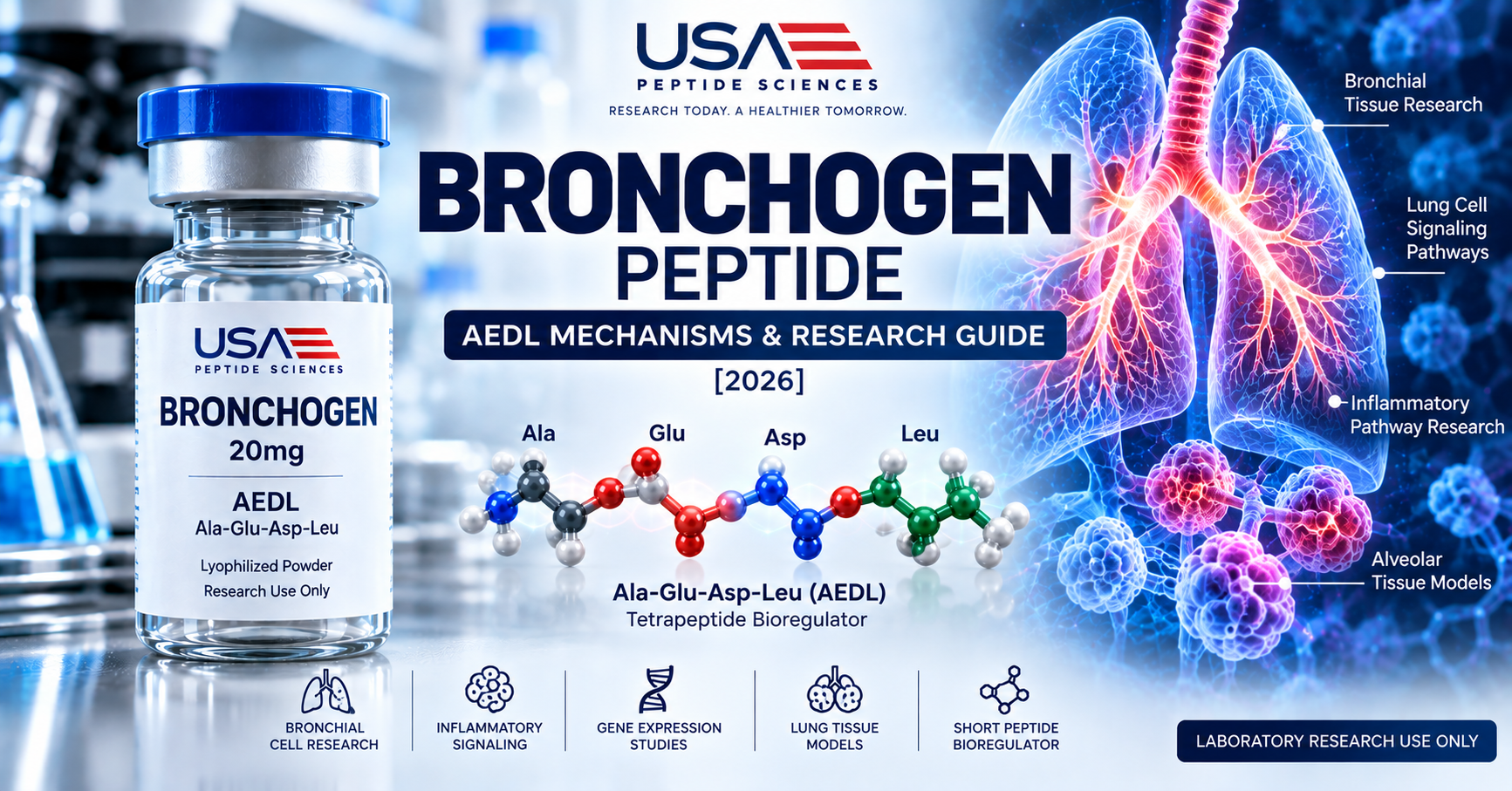
Bronchogen Peptide: AEDL Mechanisms, Lung Research & Evidence Guide [2026]
Bronchogen peptide is a synthetic short-chain bioregulator investigated primarily in experimental models involving bronchial epithelial cells, lung tissue, cellular differentiation, inflammatory signaling, DNA interactions, and age-associated changes in respiratory tissue.
The peer-reviewed literature generally identifies the compound as the tetrapeptide Ala-Glu-Asp-Leu, abbreviated AEDL.
That four-amino-acid structure places it within the wider family of ultrashort peptide bioregulators associated with the Khavinson research program.
Published studies involving AEDL include organotypic lung-tissue cultures, human bronchial epithelial cells, experimental obstructive-lung models in rats, DNA-interaction studies, and gene-expression research.
These findings provide a legitimate laboratory basis for further investigation.
They do not establish the compound as an approved treatment for respiratory disease.
USA Peptide Sciences currently lists Bronchogen Peptide 20mg Bioregulator as a laboratory research material.
What Is Bronchogen Peptide?
Bronchogen is most commonly identified in the peer-reviewed literature as:
Ala-Glu-Asp-Leu
or:
AEDL
This makes it a tetrapeptide containing four amino-acid residues.
Short peptides of this size have been investigated because they may interact with biological systems differently from conventional larger proteins or peptide hormones.
Research involving this peptide family has examined:
- cellular differentiation
- nuclear localization
- DNA interaction
- histone interaction
- gene-expression changes
- tissue-specific cellular responses
- oxidative pathways
- age-associated cellular signaling
The strongest Bronchogen-specific literature, however, centers on bronchial and pulmonary experimental models.
Bronchial Epithelial Cell Research
One particularly relevant study investigated short peptides in aging cell cultures.
Researchers measured expression of differentiation-associated factors in pancreatic, bronchial, and prostate-derived cell models.
In human bronchial epithelial cell cultures, the AEDL sequence was reported to influence expression of differentiation-associated factors including CXCL12 and HOXA3.
The effects were more pronounced in later-passage, aging cell cultures than in younger cultures.
This study provides direct support for investigating Bronchogen peptide in bronchial epithelial differentiation research.
Researchers can review the primary paper through PubMed: tissue-specific peptide effects on cell differentiation.
The findings should still be interpreted carefully.
Changes in differentiation markers in cultured bronchial cells do not prove restoration of lung function in humans.
They describe a molecular response within a controlled cell-culture model.
Lung Tissue and Organotypic Research
The compound has also been examined in organotypic lung-tissue cultures.
One study compared several synthetic bioregulator peptides in explants derived from different rat tissues.
The investigators studied compounds associated with heart, lung, prostate, and pancreatic tissue.
Bronchogen was evaluated in lung-tissue explants from both young and aged rats.
The researchers reported stimulation of growth in the corresponding lung cultures relative to controls.
This type of experiment contributed to the concept of tissue-associated short-peptide activity.
However, organotypic culture experiments do not establish selective delivery to a particular organ in a living organism.
They are useful for studying tissue-level responses under controlled laboratory conditions.
Bronchogen in Experimental Obstructive Lung Models
A separate group of studies examined Bronchogen peptide in rat models designed to reproduce features of obstructive lung pathology.
In one experiment, chronic lung injury was induced through intermittent nitrogen-dioxide exposure.
Researchers then examined:
- bronchial epithelial structure
- lung-tissue remodeling
- bronchoalveolar cell composition
- inflammatory cytokines
- secretory immunoglobulin A
- surfactant protein B
- ciliated epithelial cells
The researchers reported changes in epithelial remodeling and inflammatory markers following experimental peptide exposure.
These findings are among the strongest direct pulmonary studies involving this compound.
Researchers can review the primary article via PubMed: Bronchogen and obstructive-lung pathology research.
The model was performed in rats.
It therefore does not establish that the material treats chronic obstructive pulmonary disease, asthma, emphysema, or other respiratory disorders in humans.
Bronchial Epithelium and Tissue Remodeling
The bronchial epithelium forms an important interface between the respiratory tract and the external environment.
It contributes to:
- physical barrier function
- mucociliary clearance
- local immune signaling
- mucus regulation
- interaction with inhaled particles
- tissue repair following injury
Experimental obstructive-lung models have examined whether short peptides alter epithelial structure following prolonged tissue stress.
Published Bronchogen work reported changes involving goblet-cell hyperplasia, squamous metaplasia, lymphocytic infiltration, emphysema-associated changes, and restoration of ciliated epithelial-cell populations in the experimental model.
These observations make bronchial epithelial remodeling a reasonable research area.
They should not be translated into claims that the compound regenerates damaged human lungs.
Inflammatory-Signaling Research
Pulmonary injury frequently involves changes in immune-cell populations and cytokine signaling.
The animal research involving AEDL has therefore evaluated inflammatory parameters in bronchoalveolar lavage fluid.
Investigators examined the composition of inflammatory cells together with cytokine and enzyme profiles.
Changes observed after experimental peptide exposure were interpreted as reduced inflammatory activity within the model.
This supports laboratory investigation of inflammation-associated pathways.
It does not justify describing the compound as a clinically established anti-inflammatory drug.
Surfactant-Associated Research
Pulmonary surfactant is a complex mixture produced primarily by alveolar type II cells.
Its biological roles include reducing surface tension and helping maintain alveolar stability.
Experimental Bronchogen research has measured surfactant protein B within bronchoalveolar lavage fluid as one of several pulmonary-function-associated markers.
Changes in a surfactant-associated marker can be useful when studying pulmonary epithelial function.
However, this does not mean that AEDL has been clinically proven to increase surfactant production in people.
Bronchogen Peptide and DNA Interaction
Another important research direction involves peptide interactions with nucleic acids.
Short peptides have been studied using fluorescently labeled DNA and oligonucleotide systems to determine whether particular amino-acid sequences demonstrate preferential interactions with particular nucleotide sequences.
One study involving Bronchogen identified interactions between AEDL and DNA-containing sequences.
The researchers reported preferential interaction with certain CTG-containing oligonucleotides.
This provides an experimental basis for investigating how ultrashort peptides may participate in gene-regulatory mechanisms.
It does not establish that Bronchogen activates a predetermined set of respiratory genes in living humans.
DNA Thermostability Research
Researchers have also investigated the effect of the compound on DNA melting behavior.
A differential-scanning microcalorimetry study reported changes in DNA melting temperature in the presence of Bronchogen.
The investigators interpreted the findings as evidence of interaction between the peptide and DNA.
This type of biophysical experiment is useful because it examines peptide-DNA interaction from a different methodological angle than gene-expression studies.
It remains a laboratory measurement.
A change in DNA thermostability is not itself evidence of a therapeutic biological outcome.
Histone-Interaction Research
Histones help package DNA into chromatin and influence access to genetic information.
Several short peptide sequences, including Ala-Glu-Asp-Leu, have been studied for interaction with histone proteins.
Research using fluorescently labeled histones reported that AEDL and related short peptides interacted with histones H1, H2B, H3, and H4 under experimental conditions.
The interaction depended on peptide sequence, histone type, and oligonucleotide context.
These observations are relevant to the broader hypothesis that ultrashort peptides may participate in chromatin-associated regulation.
Further research is required before assigning specific physiological effects to these interactions.
Gene-Expression and Epigenetic Research
Bronchial epithelial aging has also been studied in relation to DNA methylation and gene-expression changes.
A published investigation reported that AEDL affected expression of several genes in aging bronchial epithelial cell cultures.
Researchers also examined promoter methylation patterns to determine whether age-associated gene-expression differences were associated with epigenetic changes.
The study suggests that short peptide research may extend beyond conventional receptor signaling into chromatin and transcription-associated biology.
This remains a developing research area.
Claims that the compound “resets” human genes or reverses biological aging would go well beyond the evidence.
What Bronchogen Peptide Research Supports
Based on currently identifiable published literature, reasonable research areas include:
- bronchial epithelial cell differentiation
- pulmonary tissue-culture models
- aging bronchial cell cultures
- tissue-remodeling pathways
- inflammatory signaling
- bronchoalveolar cytokine research
- surfactant-associated markers
- epithelial barrier models
- peptide-DNA interaction
- histone-associated research
- gene-expression studies
- DNA methylation research
Together, these provide a legitimate experimental framework for studying AEDL.
What the Evidence Does Not Establish
Current evidence does not establish that the compound:
- treats COPD in humans
- treats asthma
- repairs damaged human lungs
- prevents pulmonary fibrosis
- reverses emphysema
- improves human breathing performance
- cures respiratory infection
- reverses human lung aging
- has a clinically validated dosage
- is an FDA-approved respiratory medicine
Most relevant research involves cell culture, tissue explants, molecular assays, or animal models.
That distinction should remain clear in any responsible research discussion.
Bronchogen Compared With Other Bioregulators
AEDL can also be examined within the wider short-peptide bioregulator family.
USA Peptide Sciences carries related research materials including:
- Cardiogen
- Cortagen
- Ovagen
- Testagen
- Prostamax
- Livagen
- Cartalax
- Pinealon
Each peptide has a different amino-acid sequence and its own experimental literature.
Researchers interested in comparative short-peptide biology can also review the existing Testagen peptide research guide.
The broader inventory is available through the USA Peptide Sciences research catalog.
Creating these related research pages as a connected content cluster also helps distinguish sequence-specific evidence from general assumptions about the entire bioregulator class.
Bronchogen 20mg Research Material
USA Peptide Sciences currently lists a 20mg lyophilized Bronchogen research product.
The live product page describes HPLC-MS analytical testing, third-party verification, batch-specific documentation, and laboratory-research-only classification.
Researchers should verify the current batch documentation before experimental use.
Useful documentation can include:
- exact peptide sequence
- molecular identity
- analytical purity
- batch or lot number
- chromatographic results
- mass-spectrometry results
- contamination screening where applicable
- Certificate of Analysis
The site’s broader analytical framework can be reviewed through USA Peptide Sciences Quality Assurance.
Why Sequence Verification Is Especially Important
Sequence verification matters for every research peptide, but it is especially important here because the current USA Peptide Sciences product page contains conflicting sequence descriptions.
One section identifies the material as AED, or Ala-Glu-Asp.
Another describes the product as Ala-Glu-Asp-Leu.
The peer-reviewed Bronchogen literature discussed throughout this article predominantly identifies the compound as the AEDL tetrapeptide.
Researchers should therefore confirm the exact sequence against the current batch Certificate of Analysis rather than relying solely on webpage wording.
Sourcing Standards for Bronchogen Research
1. Confirm Molecular Identity
Verify the precise peptide sequence supplied.
Do not assume compounds with similar short-peptide names are interchangeable.
2. Review Batch-Specific Documentation
Analytical documentation should ideally reference the production lot being supplied.
3. Separate Purity From Identity
High HPLC purity does not by itself prove that the correct peptide sequence is present.
Mass-spectrometric identity information provides an additional layer of verification.
4. Evaluate Claims Against Published Evidence
Bronchial-cell and animal lung models exist.
Claims of established human respiratory treatment do not.
5. Maintain Research-Only Classification
The material should remain clearly designated for qualified laboratory and preclinical investigation.
Frequently Asked Questions About Bronchogen Peptide
What is Bronchogen peptide?
Bronchogen peptide is a short synthetic bioregulator most commonly identified in peer-reviewed research as Ala-Glu-Asp-Leu, abbreviated AEDL.
Published studies have examined bronchial epithelial cells, lung-tissue cultures, obstructive-lung animal models, gene expression, DNA interactions, and related mechanisms.
What is the Bronchogen sequence?
The sequence most frequently identified in the research literature is:
Ala-Glu-Asp-Leu
or:
AEDL
This makes it a tetrapeptide containing four amino acids.
Is Bronchogen AED or AEDL?
The peer-reviewed literature reviewed for this article generally identifies the compound as AEDL.
The current USA Peptide Sciences product page contains both AED and AEDL descriptions, so researchers should confirm the actual supplied sequence through batch-specific analytical documentation.
What has Bronchogen been studied for?
Research areas include bronchial epithelial differentiation, lung tissue cultures, experimental obstructive-lung pathology, inflammatory signaling, surfactant-associated markers, DNA interactions, and gene-expression mechanisms.
Does Bronchogen affect bronchial cells?
Published cell-culture research reported changes in differentiation-associated factors in human bronchial epithelial cells following experimental exposure to AEDL.
These are laboratory findings and do not establish clinical respiratory benefits.
Has Bronchogen been studied in COPD?
Researchers have studied the peptide in rat models designed to reproduce features of obstructive lung pathology.
That is not the same as demonstrating efficacy in people with COPD.
Does AEDL interact with DNA?
Laboratory experiments have reported interaction between short AEDL peptides and DNA or deoxyribooligonucleotide systems.
These findings support further gene-regulatory research but do not prove a specific therapeutic mechanism in humans.
Is Bronchogen FDA approved?
No FDA-approved therapeutic use is established for this research peptide.
USA Peptide Sciences supplies the material for laboratory research only.
What should researchers verify before sourcing it?
Researchers should review peptide sequence, HPLC results, identity-confirmation data, batch-specific documentation, research-use labeling, and the evidence supporting any biological claims.
Conclusion
Bronchogen peptide has a small but identifiable body of preclinical research centered on bronchial epithelial biology and pulmonary models.
Published work involving AEDL has examined cell differentiation, lung-tissue responses, experimental obstructive-lung pathology, inflammatory markers, DNA interactions, histones, and gene-expression mechanisms.
These findings make the compound a legitimate subject for controlled laboratory investigation.
They do not establish it as a respiratory therapy.
Researchers working with AEDL should therefore prioritize accurate sequence identification, batch-specific analytical verification, appropriate controls, and careful separation of experimental findings from unsupported human-use claims.
Research Use Disclaimer
This article is provided strictly for educational, scientific, and laboratory research purposes.
Bronchogen peptide, AEDL, and all related short peptide bioregulators discussed here are experimental research materials.
References to lung tissue, bronchial epithelium, inflammation, surfactant proteins, COPD models, DNA interactions, histones, gene expression, or cellular aging describe findings from laboratory, cell-culture, tissue-culture, molecular, or animal research unless explicitly stated otherwise.
These observations should not be interpreted as evidence that Bronchogen prevents, diagnoses, treats, or cures COPD, asthma, emphysema, pulmonary fibrosis, infection, or any other human medical condition.
USA Peptide Sciences research compounds are not intended for human or veterinary consumption, therapeutic administration, clinical use, or diagnosis.
All handling and experimental evaluation should be performed by appropriately qualified research professionals.