
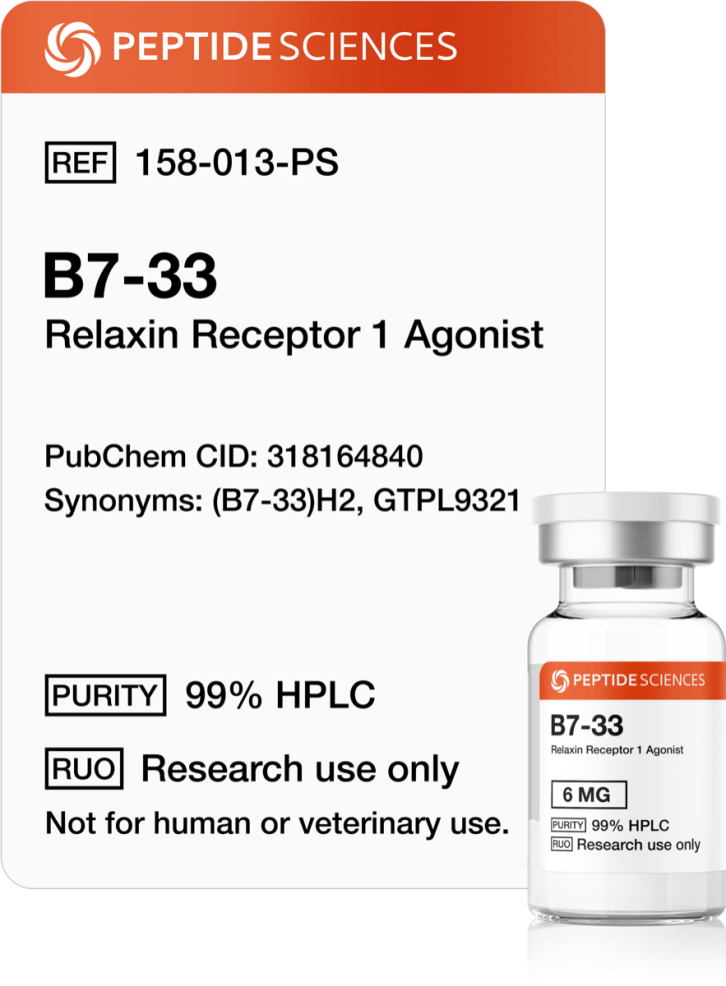

B7-33 (Relaxin Analog) 6mg
$70.00
PRODUCT SHORT DESCRIPTION
B7-33 6mg is a premium, high-purity synthetic single-chain peptide analogue of human gene-2 relaxin (H2 relaxin). This 6,000mcg configuration provides an exceptionally precise biochemical tool for investigating RXFP1 signaling pathways, matrix metalloproteinase (MMP) activation, and tissue-specific anti-fibrotic kinetics without triggering tumor-promoting cascades.
Introduction to B7-33 6mg (Relaxin Analogue)
B7-33, biochemically classified as a functional single-chain peptide analogue of the endogenous mammalian hormone human gene-2 relaxin (H2 relaxin), is a targeted molecular probe engineered for high-resolution research into cardiovascular remodeling, chronic fibrosis, pulmonology, and gestational vascular mechanics. Unlike native H2 relaxin, which features a complex, dual-chain disulfide-linked structure ($\text{A-chain}$ and $\text{B-chain}$) that presents notable synthesis and stability challenges, B7-33 is derived exclusively from a truncated, linear segment of the native receptor-binding domain.
In native biological systems, endogenous relaxin is a crucial pleiotropic hormone that modulates extracellular matrix turnover and vascular compliance. However, its long-term deployment in laboratory models can activate multi-pathway cross-talk, including the unwanted upregulation of cyclic adenosine monophosphate (cAMP) loops linked to certain oncogenic or hyperproliferative side-channel artifacts. B7-33 bypasses these experimental variables by functioning as a functionally selective, biased agonist. At USA PEPTIDE SCIENCES, we supply this advanced structural matrix as a premium 6mg lyophilized vial, providing molecular biology, pathology, and cardiology research institutions with an ultra-pure, standardized baseline reagent to map tissue-specific recovery curves and collagen remodeling kinetics.
Research Overview: Selective RXFP1 Activation and Anti-Fibrotic Kinetics
The primary scientific value of B7-33 6mg centers on its specific affinity for the Relaxin Family Peptide Receptor 1 (RXFP1). By operating as a biased agonist, it binds to RXFP1 and preferentially stimulates the extracellular signal-regulated kinase 1/2 ($\text{ERK1/2}$) and matrix metalloproteinase-9 ($\text{MMP-9}$) signaling axes while triggering minimal to no traditional $\text{G}_s$-protein-mediated cAMP accumulation. This selective signaling allows researchers to isolate pure anti-fibrotic mechanics under controlled laboratory conditions.
Key areas of active scientific investigation utilizing B7-33 6mg include:
-
Myocardial Remodeling and Post-Injury Scar Reduction: Modeling the structural maintenance of cardiac architecture following ischemic trauma or acute heart failure. In animal models of myocardial infarction, B7-33 is highly scrutinized for its capacity to reduce excessive scar tissue accumulation by roughly 50%. Researchers track the downregulation of collagen Type I and Type III synthesis within cardiac fibroblasts, observing its downstream impact on preserving left ventricular ejection fraction and extending animal longevity curves.
-
Pulmonary Fibrosis and Lung Inflammation Suppression: Investigating the modulation of extracellular matrix deposition in chronic respiratory stress frameworks. Investigators utilize B7-33 to evaluate the suppression of transforming growth factor-beta 1 ($\text{TGF-}\beta\text{1}$) induced fibrotic cascades in alveolar tissues. Studies track the inhibition of myofibroblast differentiation, assessing how the peptide mitigates structural stiffness in compromised lung tissue models.
-
Renal Homeostasis and Chronic Kidney Disease Kinetics: Tracking the preservation of functional parenchymal architecture. Researchers analyze B7-33’s capability to clear obstructive connective tissue barriers within the glomerulus and tubulointerstitial spaces, mapping the restoration of localized vascular compliance and filtration efficiency.
-
Vascular Endothelial Stabilization and Preeclampsia Simulations: Evaluating secondary gestational and vascular regulation loops. In experimental models of preeclampsia, B7-33 is studied for its ability to correct endothelial dysfunction, stimulate nitric oxide ($\text{NO}$) generation, and lower systemic vascular resistance without altering baseline heart rate parameters.
Biased Agonism and Molecular Precision
To maintain strict analytical resolution, the structural conformation of B7-33 is engineered to decouple the beneficial tissue-remodeling properties of relaxin from its wider systemic endocrinological artifacts. This precise biochemical segregation guarantees that:
-
Biased RXFP1 Signaling Verification: Cells exposed to B7-33 demonstrate direct upregulations in matrix-degrading enzymes ($\text{MMP-2}$ and $\text{MMP-9}$), allowing for clear quantification of collagen clearance curves.
-
Proliferative Variable Elimination: By avoiding standard $\text{G}_s$-driven cAMP hyper-activation, researchers can evaluate long-term anti-fibrotic dynamics without inducing unwanted proliferative or tumor-promoting artifact profiles in local cell lines.
Quality Standards & Analytical Testing
At USA PEPTIDE SCIENCES, laboratory data integrity and compound reproducibility are the fundamental core of our manufacturing operations. Every single production lot of B7-33 6mg undergoes a strict quality control validation protocol to eliminate compounding variables and experimental artifacts. We utilize High-Performance Liquid Chromatography (HPLC) coupled with Mass Spectrometry (MS) to confirm an absolute chemical purity profile of 99% or greater. This rigorous analytical validation verifies the exact single-chain sequence composition, precise molecular weight, and correct linear spatial conformation while ensuring the total absence of residual synthesis reagents, truncated fragments, heavy metals, or raw contaminants. A batch-specific Certificate of Analysis (COA) accompanies every order to guarantee absolute reproducibility.
Storage and Handling Requirements
To safeguard the complex molecular bonds and prevent structural degradation of the 6mg lyophilized cake, all vials must be stored long-term in a freezer environment at -20°C, completely shielded from light and ambient moisture. Prior to introducing the compound into your laboratory workflow, reconstitution must be carried out using an appropriate sterile, non-pyrogenic, or bacteriostatic diluent. Once transitioned into a liquid state, the peptide solution becomes highly sensitive to thermal breakdown and mechanical shear stress; reconstituted vials must be maintained under constant refrigeration at 2°C to 8°C. Researchers must dissolve the compound via a slow, gentle swirling motion, avoiding any aggressive mechanical agitation, inversion, or shaking, which can permanently disrupt the synthetic matrix.
Research Use Disclaimer
The compounds distributed by USA PEPTIDE SCIENCES, including B7-33 6mg research vials, are designated strictly for laboratory research purposes only. Under no circumstances are these products approved or intended for human or veterinary consumption, direct clinical diagnostics, or therapeutic drug administration. All handling, measuring, and experimental evaluation must be conducted exclusively by qualified scientific professionals within a certified and monitored research facility.
Reviews
Clear filtersThere are no reviews yet.