
Blog
Cardiogen Peptide: AEDR Mechanisms, Research & Sourcing Guide [2026]

Cardiogen Peptide: AEDR Mechanisms, Research & Sourcing Guide [2026]
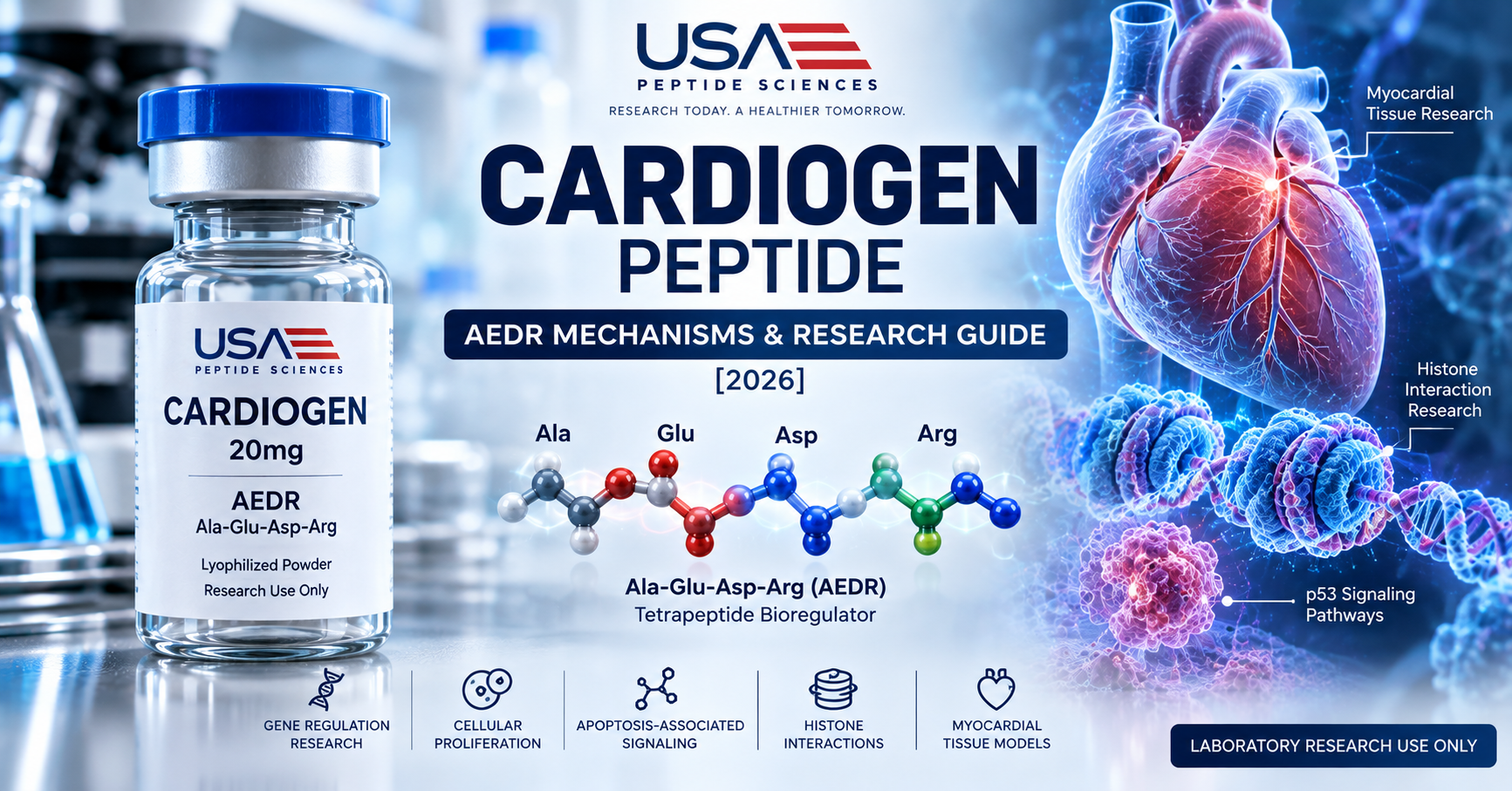
Cardiogen is a short synthetic peptide bioregulator investigated primarily in preclinical models involving myocardial tissue, cellular proliferation, apoptosis-associated signaling, and short-peptide interactions with chromatin components.
The Cardiogen research material supplied by USA Peptide Sciences is identified as the tetrapeptide Ala-Glu-Asp-Arg, abbreviated AEDR, and is available as a 20mg lyophilized research vial.
Interest in Cardiogen comes largely from the broader short-peptide bioregulator research program associated with Vladimir Khavinson and colleagues. Unlike many longer signaling peptides that primarily interact with cell-surface receptors, ultrashort peptides have also been investigated for interactions involving histones, DNA, cellular proliferation, and gene-regulatory systems.
The evidence base for Cardiogen, however, remains limited. Most published findings come from animal tissues, organotypic cultures, or other preclinical models. There are no controlled human clinical trials demonstrating therapeutic cardiovascular effects from Cardiogen itself.
For researchers evaluating laboratory material, USA Peptide Sciences provides Cardiogen 20mg Bioregulator within its broader bioregulator research catalog.
What Is Cardiogen?
Cardiogen is described in the research literature as a synthetic short peptide belonging to the tissue-associated bioregulator family.
The USA Peptide Sciences research product identifies Cardiogen as:
- Sequence: Ala-Glu-Asp-Arg
- One-letter abbreviation: AEDR
- Peptide length: four amino acids
- Classification: synthetic tetrapeptide bioregulator
- Quantity: 20mg
- Format: lyophilized research material
- Intended use: laboratory research only
The current product page places Cardiogen within the site’s Bioregulator Peptides category and supplies it as a 20mg laboratory research vial.
Cardiogen should therefore be distinguished from unrelated products and technologies that happen to share similar names. In this article, Cardiogen refers specifically to the short peptide research compound associated with myocardial and bioregulator research.
Cardiogen and the Short-Peptide Bioregulator Concept
Short peptide bioregulators generally contain only a few amino-acid residues.
Researchers have investigated these molecules because their small size may allow biological interactions different from those of larger peptides and proteins.
One body of research proposes that certain short peptides can participate in interactions involving:
- histone proteins
- chromatin-associated structures
- DNA
- cellular differentiation
- transcription-associated processes
- tissue-specific signaling
A systematic review of peptide regulation of gene expression discussed evidence that short peptides containing approximately two to seven amino-acid residues can interact with nuclei, nucleoli, histones, and DNA in experimental systems. The authors describe DNA-peptide and chromatin-associated interactions as one possible mechanism through which some short peptides may influence gene-expression processes.
These are class-level observations and should not automatically be interpreted as proof that every short peptide regulates every proposed target gene.
For Cardiogen specifically, the strongest conclusions should remain tied to experiments in which the relevant peptide or AEDR sequence was actually studied.
Cardiogen AEDR and Histone Research
One particularly relevant molecular study examined several short peptide sequences, including Ala-Glu-Asp-Arg — AEDR.
Researchers evaluated interactions between short peptides and FITC-labeled histones.
The study reported that Ala-Glu-Asp-Arg and several related ultrashort peptides interacted with histones H1, H2B, H3, and H4 in the experimental system. The researchers further reported that the interaction depended on peptide structure, histone type, and oligonucleotide context.
This study is relevant to Cardiogen because the AEDR sequence corresponds to the sequence used for the USA Peptide Sciences Cardiogen research product.
It provides experimental support for investigating AEDR as a molecular probe in chromatin- and histone-associated research.
However, histone binding should not be exaggerated into a claim that Cardiogen has been proven to activate specific cardiovascular genes in humans.
Those are two very different conclusions.
Cardiogen Research in Myocardial Tissue Cultures
The most directly relevant Cardiogen studies involve organotypic myocardial tissue.
A 2009 study investigated Cardiogen alongside individual amino acids in myocardial tissue explants from young and aged rats.
Researchers used a synthetic Cardiogen tetrapeptide and evaluated cellular proliferation and apoptosis-associated processes.
The investigators reported that Cardiogen produced a stimulating effect on proliferation in myocardial tissue cultures derived from both young and aged rats. Immunohistochemical analysis also showed reduced expression of the p53 protein in the experimental system.
The authors interpreted the reduced p53 expression as being consistent with an effect on apoptosis-associated processes in the myocardial cultures.
That finding is interesting for laboratory research because p53 participates in cellular stress responses, cell-cycle regulation, senescence, and apoptosis.
But the study was performed in organotypic rat tissue cultures.
It does not demonstrate that Cardiogen repairs human hearts, prevents cardiovascular disease, reverses myocardial damage, or produces clinical cardiovascular benefits.
Tissue-Specific Cardiogen Research
Another published study examined several synthetic peptide bioregulators across different organotypic tissue cultures.
The researchers studied:
- Cardiogen in heart tissue
- Bronchogen in lung tissue
- Prostamax in prostate tissue
- Pancragen in pancreatic tissue
The compounds were examined using explants from young and aged rats.
At the experimental concentration tested, each peptide showed a stimulating effect in its associated tissue culture relative to control explants.
This experiment is often cited in discussions about the proposed tissue specificity of short peptide bioregulators.
The result is useful as a research observation, but the evidence remains preclinical and comes from a relatively narrow research lineage.
Independent replication across multiple laboratories would strengthen confidence in claims of highly selective tissue targeting.
Cardiogen, p53 and Apoptosis Research
The p53 finding from the myocardial culture experiment deserves particular attention.
p53 is an important regulatory protein involved in cellular responses to DNA damage and stress.
Depending on cellular context, p53 signaling can contribute to:
- cell-cycle arrest
- DNA-damage responses
- cellular senescence
- apoptosis
In the Cardiogen myocardial culture study, researchers reported decreased p53 expression alongside increased proliferative activity.
That does not mean Cardiogen should simply be described as an “anti-apoptotic heart peptide.”
A more scientifically appropriate interpretation is that Cardiogen altered an apoptosis-associated marker and proliferation-related behavior in a specific ex-vivo myocardial tissue model.
Future research would be required to determine precisely how those changes occur and whether the same mechanisms reproduce across different models.
Cardiogen and Cardiovascular Cellular Aging Research
Cardiogen’s AEDR sequence has also appeared in broader cardiovascular-aging literature.
A 2022 review examining the senescence-associated secretory phenotype, or SASP, in cardiovascular cells discussed AEDR among peptides investigated in relation to molecules associated with cardiovascular cellular aging and inflammatory signaling.
SASP describes changes in signaling molecules released by senescent cells.
These can include inflammatory cytokines, matrix-associated enzymes, adhesion molecules, and proteins involved in stress and proliferation pathways.
This provides another research context for examining AEDR.
It should nevertheless be viewed as mechanistic and exploratory rather than evidence of a demonstrated cardiovascular treatment.
Cardiogen and DNA-Associated Short-Peptide Research
The broader Khavinson short-peptide literature proposes that some ultrashort peptides can interact with DNA in sequence-dependent ways.
A published study examining short peptides and DNA reported that peptides containing two to four amino-acid residues could alter eukaryotic endonuclease activity in ways associated with DNA sequence and methylation state.
The authors proposed that peptide-DNA interactions may contribute to regulation of genetic functions.
Other research involving selected short peptides has demonstrated nuclear localization and interaction with deoxyribooligonucleotides or DNA in vitro.
These findings help explain why short peptide bioregulators are studied in gene-regulation research.
However, Cardiogen-specific claims should remain narrower than general conclusions about the entire peptide class.
What Cardiogen Research Actually Supports
Based on the available published literature, Cardiogen research currently provides evidence for investigation into:
- myocardial tissue explant proliferation
- apoptosis-associated signaling
- p53 expression in myocardial tissue cultures
- tissue-specific organotypic peptide research
- AEDR interaction with histone proteins
- short-peptide chromatin biology
- cardiovascular cellular-aging mechanisms
These areas make Cardiogen an interesting experimental compound.
But there is an equally important list of conclusions the evidence does not currently establish.
What the Evidence Does Not Establish
There is currently insufficient published evidence to conclude that Cardiogen:
- treats cardiovascular disease in humans
- reverses heart failure
- repairs damaged human myocardium
- prevents myocardial infarction
- increases human cardiovascular performance
- produces established anti-aging effects in people
- has a clinically validated human dose
- is an FDA-approved cardiovascular therapy
The Cardiogen literature is predominantly preclinical.
Researchers should therefore distinguish between a mechanism observed in myocardial explants and a clinical effect in a living human cardiovascular system.
This distinction is especially important when reading online discussions that convert laboratory observations into therapeutic promises.
Cardiogen Compared With Other Bioregulators
One useful way to study Cardiogen is within the wider bioregulator family rather than as an isolated compound.
USA Peptide Sciences currently lists several related short-peptide research materials, including Bronchogen, Ovagen, Cortagen, Testagen, Prostamax and others in its bioregulator inventory.
For example, researchers can compare Cardiogen with Testagen Peptide Bioregulator research.
USA Peptide Sciences also has a dedicated Testagen peptide mechanisms and sourcing article explaining another short-chain peptide bioregulator.
As this blog series expands, Cardiogen will become part of a larger internal research cluster covering:
Cardiogen → myocardial models
Ovagen → ovarian-associated research models
Cortagen → neural and cortical research
Bronchogen → bronchial/lung-associated models
Prostamax → prostate-associated research
Testagen → KEDG and short-peptide molecular research
This internal structure makes it easier for researchers to compare how individual short peptides differ in sequence, experimental model, and evidence quality.
Cardiogen 20mg Research Material
USA Peptide Sciences currently provides Cardiogen as a 20mg lyophilized bioregulator research product.
The product page identifies the compound as Ala-Glu-Asp-Arg and states that the material undergoes HPLC and mass-spectrometry-associated analytical quality control, with batch-specific documentation used within the site’s quality framework.
Researchers can review the current Cardiogen 20mg Bioregulator research listing for the latest product specifications.
The broader catalog currently includes approximately 160 research products across peptide and research-compound categories.
Why Analytical Verification Matters for Cardiogen
Short peptides present several analytical challenges.
A material can contain peptide-like material while still failing to match the intended sequence.
This is why researchers should distinguish between purity and identity.
High-performance liquid chromatography can provide information concerning sample composition and relative purity.
Mass spectrometry provides an additional method for evaluating molecular identity based on mass characteristics.
When evaluating Cardiogen research material, useful documentation may include:
- compound identity
- expected sequence
- analytical purity
- batch or lot number
- chromatographic data
- mass-spectrometric identity information
- contamination screening where applicable
- batch-specific Certificate of Analysis
USA Peptide Sciences describes its broader verification framework on its Quality Assurance page.
The relevant question should not simply be whether a website says “99% purity.”
Researchers should ask what was measured, by which analytical method, and whether the documentation corresponds to the exact batch being supplied.
Sourcing Standards for Cardiogen Research Material
Because Cardiogen is an experimental research compound rather than an approved medicine, sourcing standards should focus on analytical transparency and scientific documentation.
1. Verify Peptide Identity
Researchers should confirm that the material being supplied is identified consistently.
For the USA Peptide Sciences Cardiogen research configuration, that sequence is Ala-Glu-Asp-Arg — AEDR.
2. Look for Batch-Specific Documentation
A generic COA provides less information than analytical documentation tied to an actual production batch.
Batch identifiers improve experimental traceability.
3. Distinguish HPLC Purity From Molecular Identity
HPLC and mass spectrometry answer related but different analytical questions.
When both are available, researchers have substantially more information about the material being evaluated.
4. Examine the Evidence Behind Mechanism Claims
Cardiogen does have published myocardial tissue-culture research.
However, researchers should distinguish those experiments from stronger claims about cardiovascular treatment or clinical outcomes.
5. Maintain Research-Only Classification
A responsible supplier should make clear that the compound is intended for laboratory investigation rather than positioning preclinical findings as medical treatment claims.
USA Peptide Sciences identifies its Cardiogen material strictly as a laboratory research product.
Frequently Asked Questions About Cardiogen
What is Cardiogen?
Cardiogen is a synthetic short peptide bioregulator investigated in preclinical research involving myocardial tissue, proliferation, apoptosis-associated signaling and short-peptide molecular interactions.
The Cardiogen product supplied by USA Peptide Sciences is identified as the tetrapeptide Ala-Glu-Asp-Arg, abbreviated AEDR.
What is the Cardiogen peptide sequence?
The USA Peptide Sciences Cardiogen 20mg research product identifies its sequence as:
Ala-Glu-Asp-Arg
The one-letter abbreviation is:
AEDR.
How many amino acids are in Cardiogen?
Cardiogen AEDR contains four amino-acid residues, making it a tetrapeptide.
What has Cardiogen been studied for?
Direct published Cardiogen research includes organotypic myocardial tissue culture from young and aged rats.
Researchers reported increased proliferative activity and reduced p53 expression in the myocardial tissue model.
Does Cardiogen interact with histones?
A peer-reviewed study examining several short peptide sequences reported that Ala-Glu-Asp-Arg interacted with histones H1, H2B, H3 and H4 in its experimental system. The degree of interaction depended on peptide, histone and oligonucleotide context.
Does Cardiogen bind directly to DNA?
Short-peptide research provides evidence that certain peptides can interact with DNA and histones, but the evidence differs by peptide and experimental model.
It is therefore more accurate to say that Cardiogen/AEDR belongs to a peptide class investigated for chromatin-associated interactions than to claim that every proposed Cardiogen-DNA interaction has been experimentally established.
Is Cardiogen a cardiac peptide?
Cardiogen is commonly described as a cardiac or myocardial bioregulator because direct preclinical studies investigated the synthetic peptide in myocardial tissue cultures.
That terminology describes its research context; it does not mean Cardiogen is an approved cardiac medication.
Has Cardiogen been studied in humans?
The research identified for Cardiogen itself is predominantly preclinical, including tissue-culture and animal studies.
Controlled human Cardiogen trials establishing cardiovascular efficacy have not been demonstrated in the evidence reviewed for this article.
Is Cardiogen FDA approved?
Cardiogen is not presented by USA Peptide Sciences as an FDA-approved therapeutic product.
It is supplied strictly as laboratory research material.
What purity should researchers look for?
Rather than relying solely on a stated percentage, researchers should look for analytical documentation showing both purity assessment and identity verification where available.
USA Peptide Sciences describes HPLC-MS and batch-specific documentation within its Cardiogen research-product quality framework.
What other peptide bioregulators can be compared with Cardiogen?
Researchers interested in short peptide bioregulators may compare Cardiogen with Testagen, Bronchogen, Cortagen, Ovagen, Prostamax and related compounds where appropriate experimental controls and validated methods are used.
Conclusion
Cardiogen occupies an interesting but still developing position within short-peptide bioregulator research.
Direct preclinical studies have examined Cardiogen in myocardial tissue cultures and reported changes in proliferation and p53-associated signaling. The AEDR sequence has also been examined experimentally in histone-binding research.
These findings provide legitimate laboratory questions for further investigation.
They do not establish Cardiogen as a cardiovascular treatment.
The strongest research approach is therefore to treat Cardiogen as an experimental short peptide whose myocardial, chromatin-associated, and cellular-aging mechanisms remain subjects for controlled laboratory investigation.
Researchers evaluating the compound can review the current Cardiogen 20mg research product, the wider USA Peptide Sciences research catalog, and the site’s Quality Assurance standards for current material and analytical information.
Research Use Disclaimer
This article is provided strictly for educational, scientific and laboratory research purposes.
Cardiogen and all peptide bioregulators discussed here are presented as experimental research compounds. References to myocardial tissue, proliferation, apoptosis, p53, histones, cardiovascular aging or other biological systems describe findings from published laboratory, tissue-culture, cellular, animal or review literature unless explicitly stated otherwise.
These findings should not be interpreted as evidence that Cardiogen prevents, treats, diagnoses or cures cardiovascular disease or any other medical condition.
Cardiogen supplied by USA Peptide Sciences is not intended for human or veterinary consumption, therapeutic use, medical administration or clinical diagnosis.
All experimental handling and evaluation should be performed by appropriately qualified research professionals.