
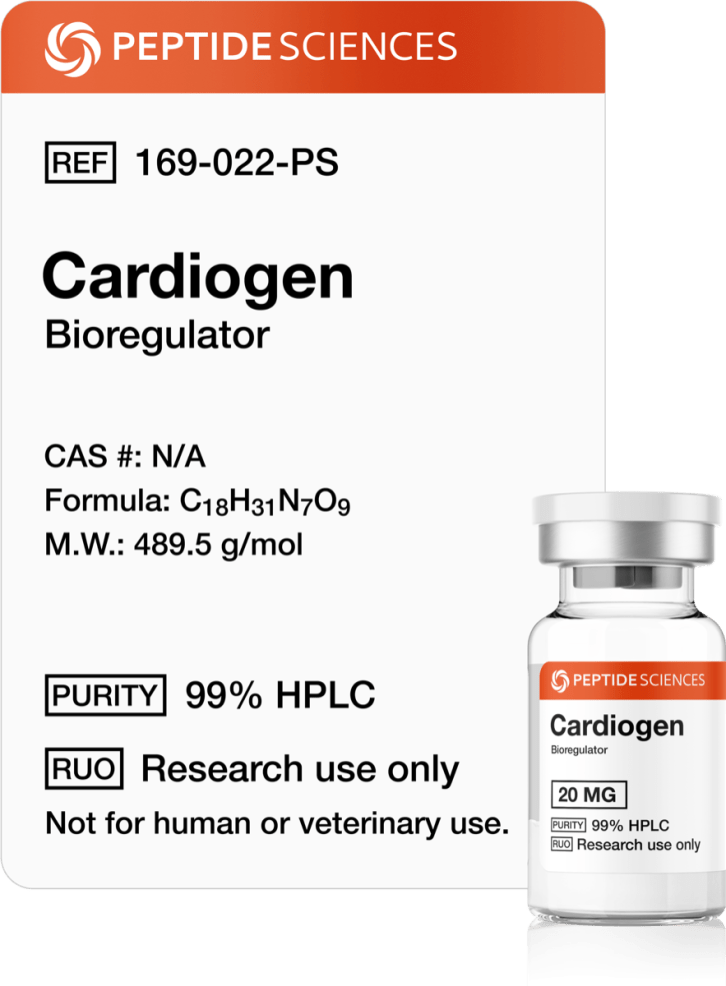
Cardiogen 20mg (Bioregulator)
$65.00
PRODUCT SHORT DESCRIPTION
Cardiogen 20mg is a premium, high-purity synthetic short-chain bioregulatory peptide engineered for advanced myocardial tissue restoration, fibroblast regulation, and prostate cell homeostasis research. This 20mg configuration provides an exceptionally precise biochemical tool for investigating DNA transcription kinetics, cardiovascular morphogenesis, and age-associated cellular senescence.
Introduction to Cardiogen 20mg Bioregulator
Cardiogen, biochemically classified as a synthetic short-chain bioregulatory tetrapeptide ($\text{L-Alanyl-L-alpha-glutamyl-L-aspartyl-L-arginine}$ or Ala-Glu-Asp-Arg), is a targeted molecular probe engineered for high-resolution studies within cardiovascular physiology, regenerative cardiology, and urological oncology research. As a prominent member of the cytogen class of bioregulators, Cardiogen is structurally derived from natural peptide fractions found endogenously within mammalian myocardial tissue. It acts as a direct epigenetic modulator, interacting with the cellular genome to regulate tissue-specific gene expression profiles.
Unlike large, complex macromolecular proteins or long-chain peptides that face significant degradation and transport barriers within the vascular matrix, Cardiogen’s ultra-low molecular weight allows it to readily penetrate cellular membranes and enter the nucleus. At USA PEPTIDE SCIENCES, we supply this advanced cardiovascular-regulatory matrix as a premium 20mg lyophilized vial, providing biochemistry, genetics, and cardiology research institutions with an ultra-pure, standardized baseline reagent to map tissue-specific transcription curves and cellular repair kinetics.
Research Overview: Myocardial Homeostasis and Fibroblast Modulation
The primary scientific value of Cardiogen 20mg centers on its capability to bind directly to specific DNA nucleotide sequences, altering the structural conformation of chromatin and modulating the expression of genes involved in cellular defense, tissue structural integrity, and apoptosis. By resetting these transcriptomic baselines, this short-chain peptide serves as a vital tool for exploring the mechanics of cardiovascular resilience.
Key areas of active scientific investigation utilizing Cardiogen 20mg include:
-
Myocardial Fibroblast Regulation and Scar Reduction: Modeling the structural maintenance of cardiac tissue following stress. Cardiogen is extensively investigated for its capacity to modulate the proliferation of myocardial fibroblasts. In damaged or ischemic cardiac tissue, hyperactive fibroblast activity can lead to excessive, non-functional connective tissue deposition (fibrosis). Researchers analyze Cardiogen to observe how it downregulates uninhibited fibroblast development, promoting a shift toward healthy, functional tissue reorganization.
-
Apoptosis Inhibition and Post-Ischemic Survival Kinetics: Investigating the preservation of cardiomyocyte viability. Following hypoxic or ischemic stress, tissue degradation is accelerated by downstream programmed cell death pathways. Researchers utilize Cardiogen to monitor the transcriptional downregulation of pro-apoptotic signals, mapping its potential to preserve myocardial architecture and support long-term structural restoration under laboratory conditions.
-
Prostate Epithelium Stabilization and Homeostasis: Analyzing the peptide’s capacity to alter secondary signaling within urological tissues. Beyond its prominent role in cardiac models, Cardiogen exhibits a tissue-specific affinity for prostate epithelial cells. Investigators utilize this peptide to track regular cellular differentiation, assessing its capability to maintain homeostatic cellular growth balance and inhibit aberrant hyperplastic or oncogenic cell lines.
-
Epigenetic Activation of Senescent DNA: Evaluating the peptide’s role in reversing age-related tissue decline. As somatic tissues age, healthy cells progressively enter a dysfunctional, non-replicative senescent state marked by heterochromatin condensation. Studies focus on how Cardiogen engages in sequence-specific binding within the promoter regions of target genes, assessing its role in unraveling silent or senescent DNA strands to restore youthful transcription profiles in aged cell cultures.
Quality Standards & Analytical Testing
At USA PEPTIDE SCIENCES, laboratory data integrity and compound reproducibility are the fundamental core of our manufacturing operations. Every single production lot of Cardiogen 20mg undergoes a strict quality control validation protocol to eliminate compounding variables and experimental artifacts. We utilize High-Performance Liquid Chromatography (HPLC) coupled with Mass Spectrometry (MS) to confirm an absolute chemical purity profile of 99% or greater. This rigorous analytical validation verifies the exact tetrapeptide sequence composition (Ala-Glu-Asp-Arg), precise molecular weight, and correct spatial conformation while ensuring the total absence of residual synthesis reagents, truncated fragments, heavy metals, or raw contaminants. A batch-specific Certificate of Analysis (COA) accompanies every order to guarantee absolute reproducibility.
Storage and Handling Requirements
To safeguard the complex molecular bonds and prevent structural degradation of the 20mg lyophilized cake, all vials must be stored long-term in a freezer environment at -20°C. Prior to introducing the compound into your laboratory workflow, reconstitution must be carried out using an appropriate sterile, non-pyrogenic, or bacteriostatic diluent. Once transitioned into a liquid state, the peptide solution becomes highly sensitive to thermal breakdown and mechanical stress; reconstituted vials must be maintained under constant refrigeration at 2°C to 8°C. Researchers must dissolve the compound via a slow, gentle swirling motion, avoiding any aggressive mechanical agitation, inversion, or shaking, which can permanently break the delicate synthetic matrix.
Research Use Disclaimer
The compounds distributed by USA PEPTIDE SCIENCES, including Cardiogen 20mg research vials, are designated strictly for laboratory research purposes only. Under no circumstances are these products approved or intended for human or veterinary consumption, direct clinical diagnostics, or therapeutic drug administration. All handling, measuring, and experimental evaluation must be conducted exclusively by qualified scientific professionals within a certified and monitored research facility.
Reviews
Clear filtersThere are no reviews yet.