
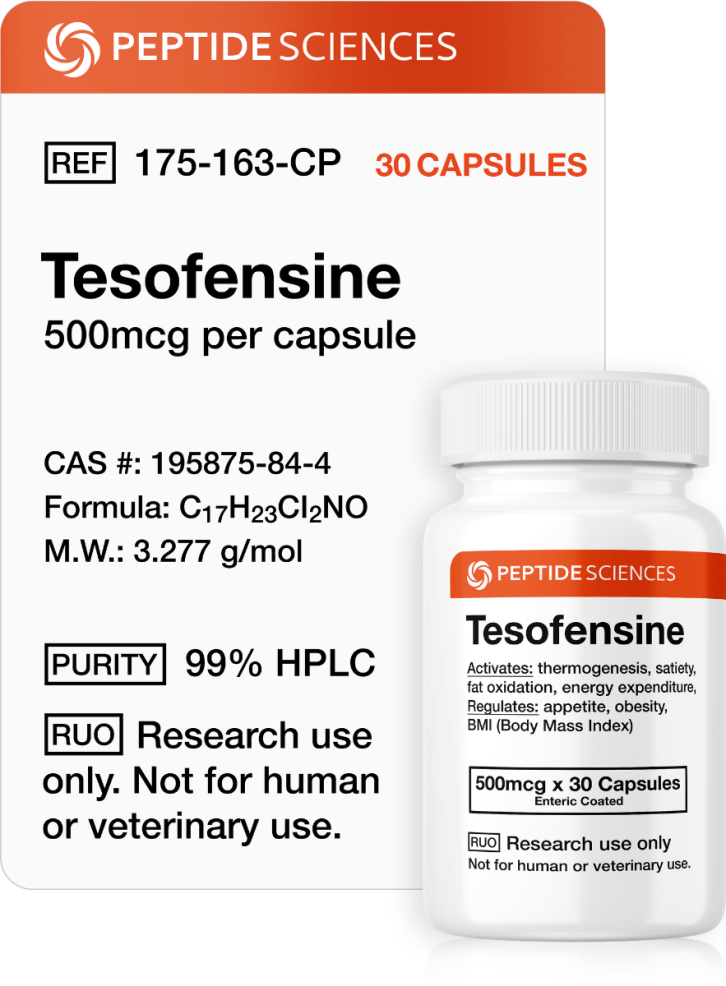
Tesofensine 500mcg (30 Capsules)
$250.00
PRODUCT SHORT DESCRIPTION
Tesofensine 500mcg (30 Capsules) from USA PEPTIDE SCIENCES is a research-grade triple monoamine reuptake inhibitor — targeting dopamine, serotonin, and noradrenaline transporter systems simultaneously — and one of the most investigated compounds in contemporary metabolic and neuro-endocrinological research. This precisely dosed encapsulated format provides investigators with a consistent, analytically verified delivery platform for studying central nervous system energy regulation, satiety signaling pathways, and monoaminergic neurotransmission dynamics. Every batch is HPLC verified to ≥99% purity and accompanied by a full Certificate of Analysis.
Tesofensine 500mcg (30 Capsules) — Advanced Triple Reuptake Inhibitor for Metabolic & Neurochemical Research
Introduction: A Uniquely Positioned Compound in Monoaminergic Research
Tesofensine 500mcg (30 Capsules) from USA PEPTIDE SCIENCES occupies a singular position within the landscape of neurochemical and metabolic research compounds. As a triple monoamine reuptake inhibitor — simultaneously engaging the dopamine transporter (DAT), serotonin transporter (SERT), and noradrenaline transporter (NET) — Tesofensine provides investigators with a pharmacologically distinct tool for modeling the intersecting neurochemical pathways that govern energy homeostasis, appetitive behavior, and central nervous system monoamine dynamics.
Originally investigated within the neurodegenerative disease research context, Tesofensine subsequently attracted significant scientific attention for its pronounced effects on body weight and metabolic parameters observed incidentally in early clinical trial populations — a finding that redirected substantial investigational focus toward its applications in obesity biology, energy expenditure modeling, and neuro-endocrine appetite regulation research. The 30-capsule encapsulated format from USA PEPTIDE SCIENCES delivers a standardized 500mcg unit dose, providing investigators with a consistent and analytically traceable compound platform across extended research protocols.
Research Overview: Scientific Background and Investigational Applications
The triple reuptake inhibitor mechanism of Tesofensine generates a research profile of exceptional breadth, spanning central neurochemistry, metabolic physiology, and behavioral neuroscience disciplines.
Triple Monoamine Transporter Inhibition Research The foundational pharmacological interest in Tesofensine centers on its simultaneous inhibition of DAT, SERT, and NET — a mechanistic profile that distinguishes it from selective reuptake inhibitors and dual-acting compounds. Preclinical and clinical research has characterized the downstream neurochemical consequences of this triple transporter blockade, including elevated synaptic concentrations of dopamine, serotonin, and noradrenaline across key brain regions involved in energy regulation, reward processing, and executive function. For investigators modeling monoaminergic signaling dynamics or studying transporter pharmacology, Tesofensine provides a uniquely comprehensive neurochemical research platform.
Energy Homeostasis and Metabolic Rate Research Among the most extensively documented areas of Tesofensine investigation is its profound influence on energy homeostasis parameters in preclinical and clinical research models. Studies have examined its effects on resting metabolic rate, thermogenic activity, and substrate utilization patterns — with findings suggesting significant increases in energy expenditure beyond those attributable to reduced caloric intake alone. This dual-mechanism metabolic profile — combining appetite suppression with enhanced energy expenditure — has made Tesofensine a compound of substantial interest in obesity biology and metabolic disease research.
Hypothalamic Appetite Regulation and Satiety Signaling Tesofensine’s neurochemical effects on hypothalamic monoamine systems have positioned it as a valuable investigational tool in appetite regulation research. Preclinical studies have explored its interactions with hypothalamic feeding circuits — including the arcuate nucleus, lateral hypothalamic area, and paraventricular nucleus — and its modulatory effects on orexigenic and anorexigenic neuropeptide expression profiles, including NPY, AgRP, POMC, and CART. These investigations contribute to a broader understanding of central satiety signaling architecture and its pharmacological modulation.
Dopaminergic Reward Pathway Research The dopamine transporter inhibitory component of Tesofensine’s mechanism introduces a significant dopaminergic research dimension. Preclinical investigations have explored its effects on mesolimbic and mesocortical dopamine dynamics — examining its interactions with reward valuation circuits, hedonic feeding behavior models, and motivational salience pathways. These research directions are of particular relevance to investigators studying the neurochemical overlap between homeostatic energy regulation and reward-driven appetitive behavior.
Noradrenergic Sympathetic Activation Modeling Tesofensine’s noradrenaline transporter inhibition contributes a sympathomimetic dimension to its research profile. Studies have examined its effects on sympathetic nervous system activation parameters — including heart rate, blood pressure dynamics, and thermogenic brown adipose tissue activity — providing investigators with a pharmacological tool for modeling noradrenergic contributions to metabolic rate regulation and autonomic energy expenditure control.
Neurodegenerative Disease Research Context Tesofensine’s original investigational context — Parkinson’s and Alzheimer’s disease research — remains a scientifically relevant framework for contemporary investigators. Its monoaminergic mechanism intersects with the dopaminergic and noradrenergic deficits characteristic of neurodegenerative pathology, and its cognitive effects observed in early clinical research have maintained interest in its applications for studies of monoamine-dependent cognitive function, attention, and executive processing.
Quality Assurance & Analytical Testing
The encapsulated format of Tesofensine 500mcg (30 Capsules) introduces additional quality considerations beyond standard peptide verification — and USA PEPTIDE SCIENCES meets these demands with full analytical rigor.
Each production batch undergoes:
- HPLC (High-Performance Liquid Chromatography): Chromatographic analysis confirming compound purity, content uniformity across capsule units, and the complete absence of synthesis impurities or degradation byproducts
- Capsule Content Uniformity Testing: Verification that each individual 500mcg capsule unit delivers a consistent, accurately dosed compound quantity within accepted analytical variance parameters
- Mass Spectrometry (MS): Molecular identity confirmation of the active Tesofensine compound, verifying structural integrity and ruling out adulteration or substitution
- Endotoxin and Sterility Screening: Applied to raw compound prior to encapsulation to meet the safety standards of professional research environments
Every 30-capsule unit is released at confirmed ≥99% purity, with a comprehensive Certificate of Analysis (COA) available through the USA PEPTIDE SCIENCES documentation platform. Full analytical traceability supports institutional compliance, research reproducibility, and publication-grade data integrity standards.
Encapsulation is performed under controlled conditions using pharmaceutical-grade excipients, ensuring chemical stability and content uniformity throughout storage, transit, and laboratory dispensing.
Storage & Handling Recommendations for Laboratory Use
Maintaining the analytical integrity and content uniformity of Tesofensine 500mcg (30 Capsules) requires consistent application of appropriate storage and handling standards throughout the research lifecycle.
Recommended storage conditions:
- Standard storage: 15–25°C (controlled room temperature) in a sealed, moisture-free, light-protected environment away from direct heat sources
- Extended archival storage: 2–8°C in a sealed container for long-term compound preservation
- Keep capsules in their original sealed packaging until use to preserve content integrity and prevent moisture-induced degradation
- Do not expose to temperature extremes, high humidity environments, or prolonged direct light — conditions that may compromise capsule shell integrity and compound stability
- Handle and dispense under appropriate laboratory conditions using standard compound management protocols consistent with institutional safety guidelines
Research Use Disclaimer
Tesofensine 500mcg (30 Capsules) supplied by USA PEPTIDE SCIENCES is intended exclusively for laboratory research and preclinical scientific investigation. This compound has not been approved by the U.S. Food and Drug Administration or any equivalent international regulatory authority for human consumption or therapeutic use.
This product is not a pharmaceutical, dietary supplement, or weight management preparation of any kind. It is not intended to diagnose, treat, cure, or prevent any disease or medical condition, and must not be self-administered or dispensed to human subjects outside of a properly licensed, ethically approved, and institutionally supervised research context.
By completing a purchase, the acquiring party confirms they are a qualified research professional procuring this compound solely for lawful scientific investigation in full compliance with all applicable federal, state, and local regulations.
USA PEPTIDE SCIENCES is steadfast in its commitment to supplying the global research community with analytically verified, precisely dosed, and fully documented compounds — because the integrity of metabolic and neurochemical research begins with the integrity of its source materials.
Reviews
Clear filtersThere are no reviews yet.