
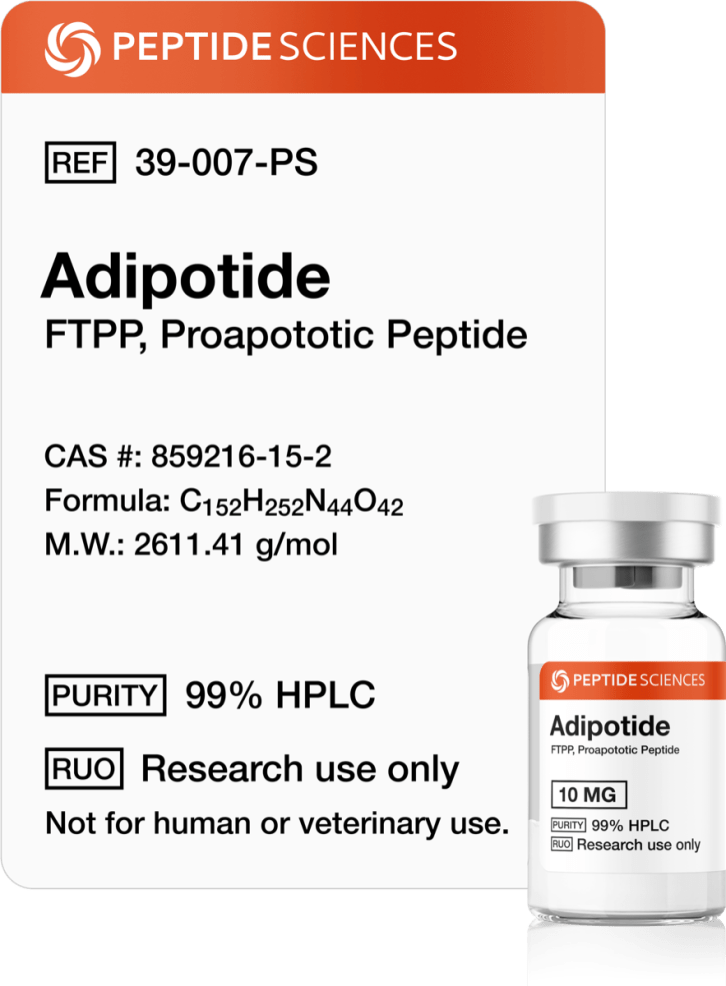
Adipotide (FTPP) 10mg
$89.00
PRODUCT SHORT DESCRIPTION
Adipotide (FTPP) 10mg is a premium, high-purity synthetic peptidomimetic engineered for advanced metabolic, adipocyte apoptosis, and targeted vascular disruption research. This 10,000mcg configuration provides an exceptionally precise biochemical tool for investigating prohibitin-targeted cell death and fat tissue neovascularization kinetics.
Introduction to Adipotide 10mg (Fat Targeted Pro-apoptotic Peptide)
Adipotide, biochemically designated as FTPP or pro-apoptotic peptide (PAP), is a highly specialized, synthetic peptidomimetic platform engineered for intensive investigation within endocrinology, vascular biology, and advanced metabolic disease kinetics. Structurally configured as a homodimeric peptide chimerism, Adipotide features two distinct functional domains: a targeted homing sequence ($\text{CKGGRAKDC}$) linked via a glycyl bridge to a pro-apoptotic mitochondrial-disrupting domain ($\text{D(KLAKLAK)}_2$). This unique dual-domain design serves as a molecular probe to study the selective destruction of the microvascular networks feeding white adipose tissue (WAT).
Unlike traditional metabolic modifiers that rely on systemic central nervous system stimulation or the alteration of global satiety hormones, Adipotide is engineered to execute localized, tissue-specific ischemia. By targeting an intracellular protein membrane assembly expressed preferentially on the endothelium of white fat blood vessels, the compound induces rapid programmed cell death within those specific vessel walls. At USA PEPTIDE SCIENCES, we supply this advanced vascular targeting tool as a premium 10mg lyophilized vial, providing molecular biology, pathology, and obesity research institutions with an ultra-pure, standardized baseline reagent to map fat tissue involution and metabolic adaptation curves.
Research Overview: Prohibitin Targeting and Adipocyte Ischemia
The primary scientific value of Adipotide 10mg centers on its capacity to decouple fat tissue volume from systemic caloric intake by physically dismantling the supportive capillary network of white adipose deposits. By triggering localized endothelial apoptosis, this peptidomimetic allows researchers to study cell-autonomous tissue regression under controlled laboratory conditions.
Key areas of active scientific investigation utilizing Adipotide 10mg include:
-
Prohibitin Membrane Agonism and Vascular Homing: Modeling the highly specific interaction with prohibitin ($\text{PHB}$). Prohibitin is a multifunctional membrane protein that serves as a unique vascular marker, selectively overexpressed on the endothelial surface of vessels vascularizing white fat tissue, while remaining largely absent in brown adipose or thin structural capillary beds. Researchers utilize Adipotide to track how the $\text{CKGGRAKDC}$ domain homes into this receptor matrix to initiate localized binding sequences.
-
Mitochondrial Membrane Disruption and Programmed Cell Death: Investigating the intracellular apoptosis cascade driven by the $\text{D(KLAKLAK)}_2$ structural sequence. Upon internalization into the targeted endothelial cell, the amphipathic peptide sequence shifts conformation to directly disrupt the integrity of the mitochondrial membrane. This triggers a massive release of cytochrome c, activating caspase-3 and caspase-9 loops, which rapidly culminates in the apoptotic destruction of the vessel wall.
-
Adipocyte Atrophy and Ischemic Tissue Involution: Analyzing the secondary impact of vascular collapse on surrounding fat tissue blocks. Deprived of oxygen and vital nutrient transport channels, the local white adipocytes undergo severe structural atrophy, leading to cellular resorption and tissue-wide remodeling independently from dietary caloric restrictions.
-
Metabolic Homeostasis and Secondary Biomarker Kinetics: Tracking systemic metabolic adaptations following rapid adipose regression. In animal models of diet-induced obesity, researchers utilize Adipotide to monitor concurrent changes in peripheral insulin sensitivity, fasting blood glucose clearance curves, and circulating lipid profiles, evaluating the compound’s broader impact on metabolic syndrome markers.
-
Renal Filtration Dynamics and Reversible Stress Vectors: Evaluating the compound’s secondary interaction fields. A primary focus in pathology trials is mapping the reversible cellular stress observed within proximal renal tubule configurations, allowing researchers to quantify safe dosage ceilings and calculate clear clearance kinetics.
Compound Profiles and Functional Architecture
To support rigorous, repeatable analytical trials, the structural layout of Adipotide 10mg is organized with high synthetic precision to ensure cross-species reactivity and complete chemical stability:
-
Homing Sequence: A cyclic peptide configuration ($\text{CKGGRAKDC}$) featuring a localized disulfide bridge, optimized for high-affinity binding to endothelial prohibitin complexes.
-
Apoptotic Sequence: An all-D-amino acid enantiomer configuration ($\text{D(KLAKLAK)}_2$) engineered specifically to resist intracellular proteolytic breakdown, ensuring the molecule successfully reaches the target mitochondrial lipid bilayer intact.
Quality Standards & Analytical Testing
At USA PEPTIDE SCIENCES, laboratory data integrity and compound reproducibility are the fundamental core of our manufacturing operations. Every single production lot of Adipotide (FTPP) 10mg undergoes a severe quality control validation protocol to eliminate compounding variables and experimental artifacts. We utilize High-Performance Liquid Chromatography (HPLC) coupled with Mass Spectrometry (MS) to confirm an absolute chemical purity profile of 99% or greater. This rigorous analytical validation verifies the exact chimeric sequence layout, correct disulfide bridge formations, precise molecular weight, and correct spatial conformation while ensuring the total absence of residual synthesis reagents, truncated fragments, heavy metals, or raw contaminants. A batch-specific Certificate of Analysis (COA) accompanies every order to guarantee absolute reproducibility.
Storage and Handling Requirements
To safeguard the complex molecular structures and prevent premature thermal or mechanical breakdown of the 10mg lyophilized cake, all vials must be stored long-term in a freezer environment at -20°C, completely shielded from light and ambient moisture. Prior to introducing the compound into your laboratory workflow, reconstitution must be carried out using an appropriate sterile, non-pyrogenic, or bacteriostatic diluent. Once transitioned into a liquid state, the peptide solution becomes highly sensitive to thermal degradation and mechanical shear stress; reconstituted vials must be maintained under constant refrigeration at 2°C to 8°C. Researchers must dissolve the compound via a slow, gentle swirling motion, avoiding any aggressive mechanical agitation, inversion, or shaking.
Research Use Disclaimer
The compounds distributed by USA PEPTIDE SCIENCES, including Adipotide (FTPP) 10mg research vials, are designated strictly for laboratory research purposes only. Under no circumstances are these products approved or intended for human or veterinary consumption, direct clinical diagnostics, or therapeutic drug administration. All handling, measuring, and experimental evaluation must be conducted exclusively by qualified scientific professionals within a certified and monitored research facility.
Reviews
Clear filtersThere are no reviews yet.