
Blog

RANK MATH SEO DETAILS
Primary Focus Keyword: cortagen peptide
Secondary Keywords:
Cortagen
AEDP peptide
Ala-Glu-Asp-Pro
Cortagen 20mg
brain cortex peptide
short peptide bioregulator
Khavinson peptide
neural peptide research
cerebral cortex research
peptide bioregulator
SEO Title: Cortagen Peptide: AEDP Research & Mechanisms Guide 2026
URL Slug: cortagen-peptide-research
Meta Description: Explore Cortagen peptide research, AEDP structure, brain-cortex studies, ischemia models, gene expression, evidence limits, and sourcing standards.
WordPress Category: Bioregulator Research
Suggested Tags:
Cortagen
AEDP Peptide
Ala-Glu-Asp-Pro
Peptide Bioregulators
Khavinson Peptides
Brain Research
Short Peptides
Featured Image Alt Text:
Cortagen peptide AEDP neural bioregulator research guide USA Peptide Sciences
Recommended Schema:
Article
FAQ
Cortagen Peptide: AEDP Mechanisms, Neural Research & Evidence Guide [2026]
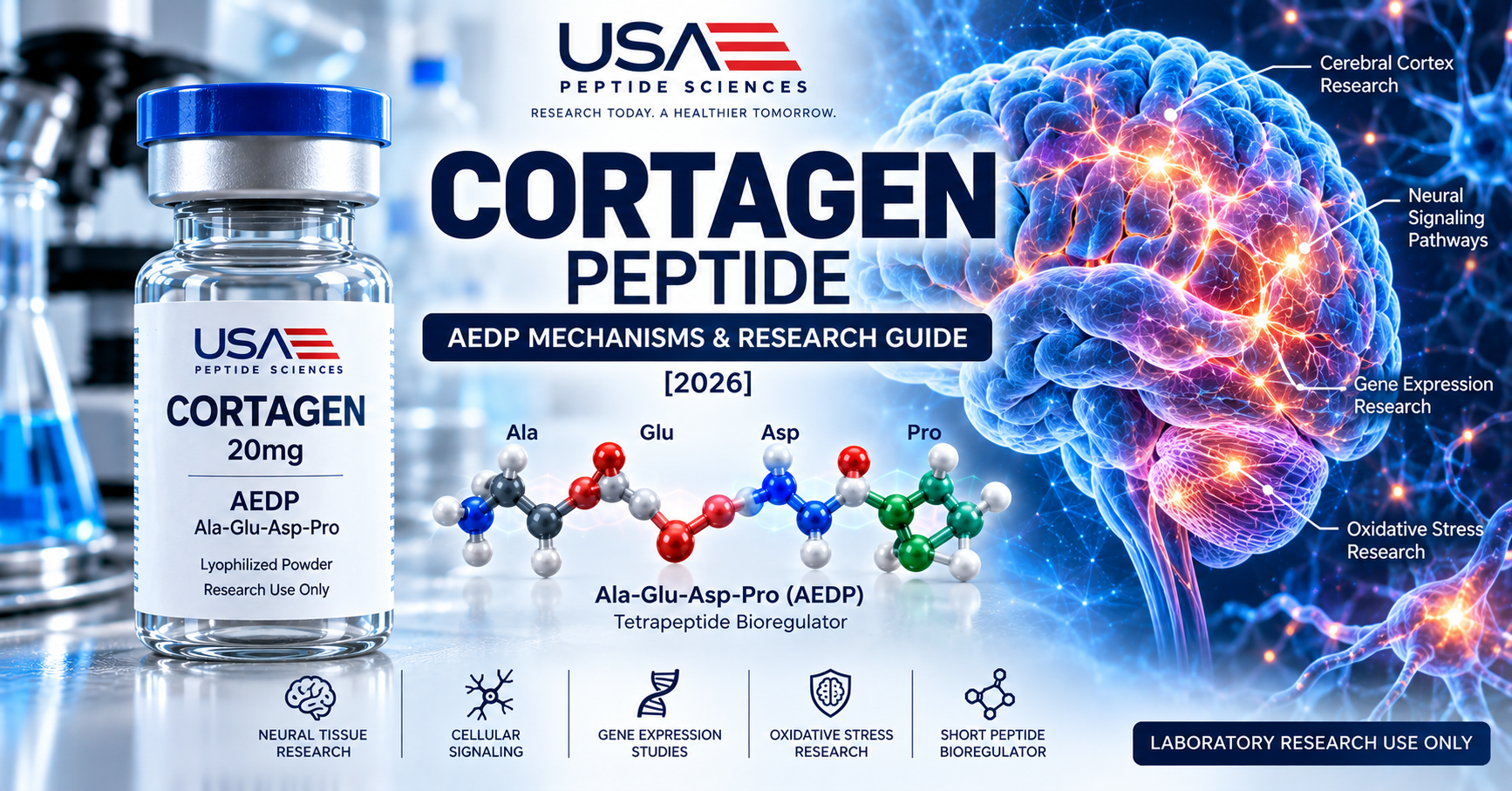
Cortagen peptide is a synthetic short-chain bioregulator identified in peer-reviewed research as the tetrapeptide Ala-Glu-Asp-Pro, abbreviated AEDP. It belongs to the broader family of ultrashort peptides investigated in connection with tissue-specific signaling, gene expression, brain-cortex models, immune signaling, oxidative processes, and age-associated cellular changes.
The strongest research surrounding this compound remains preclinical. Published experiments have examined organotypic rat brain-cortex cultures, chronic cerebral-ischemia models, oxidative-stress markers, interleukin-2 expression, and chromatin-associated processes.
That makes Cortagen peptide an interesting experimental tool for neuroscience and short-peptide research, but it does not establish the compound as a clinically proven neuroprotective treatment.
USA Peptide Sciences currently supplies Cortagen Peptide 20mg Bioregulator strictly for laboratory research.
What Is Cortagen Peptide?
Cortagen is identified in the scientific literature as a synthetic tetrapeptide composed of four amino acids:
Ala-Glu-Asp-Pro
Its one-letter abbreviation is:
AEDP
The peptide was developed through research on short peptide fractions associated with cerebral cortex tissue and belongs to the peptide bioregulator framework associated with Vladimir Khavinson and collaborators.
Its compact four-amino-acid structure distinguishes it from large peptide hormones and proteins.
Rather than behaving simply as a conventional receptor-targeting peptide, short bioregulators have also been investigated for possible interactions involving:
- cellular signaling
- gene-expression pathways
- chromatin organization
- immune-associated signaling
- tissue-specific cellular responses
- oxidative processes
- age-associated molecular changes
These proposed mechanisms remain an active area of investigation rather than a settled biological model.
Cortagen and Brain-Cortex Research
One of the most directly relevant studies examined several synthetic short peptides in organotypic tissue cultures.
Researchers evaluated Cortagen, Epithalon, Livagen, and Vilon using explants derived from several rat tissues.
The study reported that Cortagen stimulated growth of explants derived from the cerebral cortex, while the other peptides showed activity associated with different tissues.
This experiment contributed to the idea that some short peptide bioregulators may demonstrate tissue-associated effects under specific experimental conditions.
Researchers can review the original PubMed study on tissue-specific short peptide effects.
The result is scientifically interesting, but it needs to be interpreted narrowly.
An increase in cerebral-cortex explant growth in an organotypic culture does not demonstrate improved cognition, memory, neurological recovery, or brain performance in humans.
It provides a laboratory observation that can support further mechanistic research.
Tissue-Specific Effects in Different Age Groups
Additional organotypic research investigated tissue cultures from rats of different ages.
Researchers compared natural polypeptide preparations and synthetic short peptides in cerebral cortex, subcortical, liver, and thymus cultures.
The findings again suggested that peptide effects differed according to tissue type and experimental context.
This area of Cortagen peptide research helped establish the compound’s association with cerebral-cortex models.
However, the tissue-specific model still requires careful interpretation.
A peptide demonstrating activity in one tissue culture does not necessarily mean that it selectively accumulates in that tissue in a living organism or that it produces a corresponding therapeutic effect.
Tissue culture provides a controlled experimental system rather than a complete physiological model.
Cortagen Peptide and Chronic Cerebral Ischemia Models
A separate line of research examined the peptide in animal models of chronic cerebral ischemia.
In one rat study, researchers compared Cortagen with Cortexin in animals subjected to chronic brain ischemia.
The researchers evaluated behavioral changes together with metabolic and oxidative processes in brain tissue.
The study reported recovery-related changes in behavior and reductions in excessive lipid peroxidation, together with preservation of antioxidant activity under the experimental conditions.
The PubMed-indexed study on Cortagen in chronic cerebral ischemia models provides the original experimental summary.
These results help explain why the peptide appears frequently in neurobiology and cerebral-ischemia research discussions.
They do not establish efficacy in human stroke, vascular dementia, traumatic brain injury, or other neurological conditions.
The model involved experimentally induced ischemia in rats.
Oxidative-Stress Research
Oxidative stress represents another recurring area in the published Cortagen literature.
Reactive oxygen species and related oxidative processes are routinely studied because excessive oxidation can damage lipids, proteins, nucleic acids, and cellular membranes.
Animal experiments involving AEDP have examined:
- lipid peroxidation products
- protein oxidation
- antioxidant activity
- brain-tissue oxidative balance
- serum oxidative markers
One study involving rats reported changes in lipid-peroxidation products and oxidative modification of proteins following exposure to short tetrapeptides including Cortagen.
These experiments suggest that redox-associated pathways may contribute to the compound’s biological effects in research models.
However, describing the peptide as a clinically proven antioxidant would go beyond the available evidence.
The research demonstrates changes in measured biochemical markers under controlled experimental conditions.
Cortagen and IL-2 Gene Expression
The research program has also investigated immune-associated signaling.
Interleukin-2, commonly abbreviated IL-2, is a cytokine involved in lymphocyte activation, proliferation, and communication between immune cells.
In cultured mouse splenocytes, researchers examined synthetic peptides including Vilon, Epithalon, and Cortagen.
The study reported increased IL-2 mRNA synthesis after peptide exposure, although the magnitude of the response differed between compounds.
Additional animal work examined IL-2 gene expression in hypothalamic structures following administration of short peptides.
These observations make IL-2 signaling a legitimate experimental area for AEDP research.
They do not show that the compound functions as a general immune stimulant or clinically useful immunotherapy.
Changes in cytokine gene expression can have very different biological consequences depending on cell type, concentration, timing, and experimental environment.
Gene-Expression Research
Short peptide bioregulators have attracted attention partly because of studies examining changes in gene expression.
A published microarray investigation evaluated Cortagen in relation to gene expression in mouse heart tissue.
The researchers used transcriptomic analysis to identify genes whose expression changed following experimental exposure.
This line of work illustrates an important point about ultrashort peptides.
Researchers are not studying them solely for traditional receptor interactions.
They are also examining whether they influence broader transcriptional patterns and cellular regulatory networks.
A change in gene expression, however, does not automatically indicate a beneficial biological effect.
Transcriptomic studies typically generate hypotheses that require independent validation at the RNA, protein, cellular, and physiological levels.
Chromatin and Epigenetic Research
Another research direction involves chromatin.
Chromatin consists of DNA together with histone and other structural proteins that help organize genetic material inside the nucleus.
Changes in chromatin condensation influence whether particular genomic regions are more or less accessible to transcription-associated machinery.
Short peptide bioregulators, including AEDP, have been evaluated in cultured lymphocytes for effects involving:
- heterochromatin condensation
- ribosomal gene activity
- chromosome structural regions
- sister chromatid exchange
- age-associated chromatin organization
Some studies reported changes in chromatin organization after exposure to several peptide bioregulators.
This has contributed to the hypothesis that short peptides may influence gene-regulatory systems indirectly through chromatin-associated mechanisms.
It remains inappropriate to describe these findings as proof that Cortagen “reverses genetic aging.”
The experiments describe measurable cytogenetic changes in specific cell-culture systems.
What Cortagen Peptide Research Supports
The published evidence provides reasonable support for investigating AEDP in:
- cerebral-cortex tissue culture
- brain-cortex explant proliferation
- chronic cerebral-ischemia animal models
- oxidative-stress pathways
- lipid-peroxidation research
- antioxidant-associated signaling
- IL-2 gene-expression models
- short-peptide transcriptional research
- chromatin organization
- age-associated cellular signaling
Together, these areas provide a meaningful experimental basis for further study.
They also demonstrate why careful evidence interpretation matters.
What the Research Does Not Establish
Current evidence does not establish that Cortagen peptide:
- treats stroke in humans
- restores human cognitive function
- improves memory in healthy individuals
- reverses dementia
- repairs human nerve damage
- prevents neurodegenerative disease
- reverses human brain aging
- has an established clinical dosage
- is an FDA-approved neurological treatment
The majority of the relevant literature consists of animal experiments, cultured cells, organotypic tissue models, and mechanistic studies.
Claims about human neurological outcomes therefore go beyond what these experiments demonstrate.
Cortagen Compared With Other Peptide Bioregulators
Cortagen belongs to a larger family of short peptide bioregulators.
USA Peptide Sciences currently carries several related research compounds, including:
- Cardiogen
- Ovagen
- Testagen
- Bronchogen
- Prostamax
- Livagen
- Cartalax
- Pinealon
Each compound has a different amino-acid sequence and a different body of experimental literature.
For example, the existing Testagen peptide research guide reviews a KEDG tetrapeptide investigated in a different group of short-peptide models.
Researchers can also browse the broader USA Peptide Sciences research catalog for comparative laboratory materials.
This type of internal research cluster makes it easier to compare what has actually been demonstrated for each peptide rather than assuming that all short bioregulators share the same mechanisms.
Cortagen 20mg Research Material
USA Peptide Sciences currently provides a 20mg Cortagen research product in lyophilized form.
Researchers working with short peptides should distinguish analytical purity from molecular identity.
High-performance liquid chromatography can help characterize:
- purity percentage
- impurity profiles
- sample composition
- chromatographic consistency
Mass spectrometry can provide additional information relating to molecular mass and compound identity.
Useful batch documentation may therefore include:
- peptide name
- verified amino-acid sequence
- quantity
- lot or batch number
- HPLC results
- mass-spectrometry data
- Certificate of Analysis
- contamination-screening information where applicable
- appropriate laboratory storage information
USA Peptide Sciences describes its wider verification framework on the Quality Assurance page.
Why Sequence Verification Matters
Sequence verification is particularly important with short peptide bioregulators because a change involving only one amino acid creates a different compound.
For example:
Cortagen = Ala-Glu-Asp-Pro
Epitalon = Ala-Glu-Asp-Gly
These sequences differ by only their final amino acid.
Despite the structural similarity, they should not be treated as interchangeable materials.
An analytical result showing high peptide purity does not by itself prove that the intended sequence is present.
Identity verification is therefore an essential part of laboratory sourcing.
Sourcing Standards for Cortagen Research
Researchers evaluating Cortagen peptide material should apply several basic standards.
1. Confirm the Sequence
The scientific literature identifies the compound as Ala-Glu-Asp-Pro, abbreviated AEDP.
Sequence information should be consistent across the product label, Certificate of Analysis, and analytical documentation.
2. Review Batch-Specific Documentation
A generic COA provides less experimental traceability than documentation linked to the actual production batch.
3. Distinguish Purity From Identity
HPLC purity and molecular-identity verification answer different questions.
Both are useful when evaluating research material.
4. Examine the Evidence Behind Research Claims
Brain-cortex cultures and animal ischemia models provide legitimate areas of investigation.
They should not be converted into unsupported claims about treating neurological disease.
5. Maintain Research-Only Classification
The product should remain clearly designated for qualified laboratory research rather than human or veterinary administration.
Frequently Asked Questions About Cortagen Peptide
What is Cortagen peptide?
Cortagen peptide is a synthetic short peptide bioregulator identified in peer-reviewed research as the tetrapeptide Ala-Glu-Asp-Pro, abbreviated AEDP.
It has been investigated primarily in brain-cortex, gene-expression, oxidative-stress, immune-signaling, and other preclinical research models.
What is the Cortagen sequence?
The published sequence is:
Ala-Glu-Asp-Pro
Its abbreviation is:
AEDP
This makes the compound a tetrapeptide containing four amino-acid residues.
Is Cortagen a dipeptide?
No.
The PubMed-indexed scientific literature identifies Cortagen as Ala-Glu-Asp-Pro, which contains four amino acids and is therefore a tetrapeptide.
What has Cortagen been studied for?
Published research has examined cerebral-cortex tissue cultures, chronic cerebral-ischemia rat models, oxidative processes, IL-2 expression, gene-expression changes, and chromatin-associated mechanisms.
Does Cortagen affect brain tissue?
Organotypic research reported stimulation of rat cerebral-cortex explant growth, while animal studies have examined biochemical and behavioral endpoints in experimental cerebral-ischemia models.
These findings remain preclinical.
Does Cortagen reduce oxidative stress?
Animal studies have reported changes in lipid-peroxidation products, protein oxidation, and antioxidant-associated parameters.
These results describe research models rather than established clinical antioxidant effects.
Does Cortagen influence gene expression?
Several studies involving AEDP and related short peptides have investigated changes in gene expression, IL-2 mRNA, chromatin organization, and transcriptomic patterns.
The mechanisms remain an active research area.
Has Cortagen been clinically proven in humans?
The strongest readily verifiable evidence is predominantly preclinical.
The literature reviewed for this article does not establish controlled human clinical efficacy for neurological disease.
Is Cortagen FDA approved?
Cortagen is not presented by USA Peptide Sciences as an FDA-approved medication.
It is supplied strictly as laboratory research material.
Where can researchers review the product?
Researchers can review the current Cortagen Peptide 20mg Bioregulator listing and associated batch documentation before incorporating the material into an experimental workflow.
Conclusion
Cortagen peptide is a short AEDP tetrapeptide with an identifiable but predominantly preclinical research history.
Published studies have examined cerebral-cortex explant growth, brain ischemia models, oxidative pathways, IL-2 signaling, gene expression, and chromatin-associated mechanisms.
Those findings provide legitimate research questions without establishing clinical neurological benefits.
The most scientifically appropriate approach is therefore to treat AEDP as an experimental peptide bioregulator whose mechanisms remain under investigation.
Researchers evaluating the material should prioritize verified sequence identity, batch-specific analytical documentation, appropriate experimental controls, and careful distinction between preclinical evidence and human therapeutic claims.
Research Use Disclaimer
This article is provided strictly for educational, scientific, and laboratory research purposes.
Cortagen peptide, AEDP, and all related peptide bioregulators discussed here are experimental research materials.
References to cerebral cortex, ischemia, oxidative stress, gene expression, IL-2, chromatin, aging, or other biological pathways describe laboratory, cellular, tissue-culture, or animal findings unless explicitly stated otherwise.
These observations should not be interpreted as evidence that Cortagen prevents, treats, diagnoses, or cures stroke, dementia, neurological injury, neurodegenerative disease, or any other human medical condition.
USA Peptide Sciences research compounds are not intended for human or veterinary consumption, therapeutic administration, clinical use, or diagnosis.
All handling and experimental evaluation should be performed by appropriately qualified research professionals.