
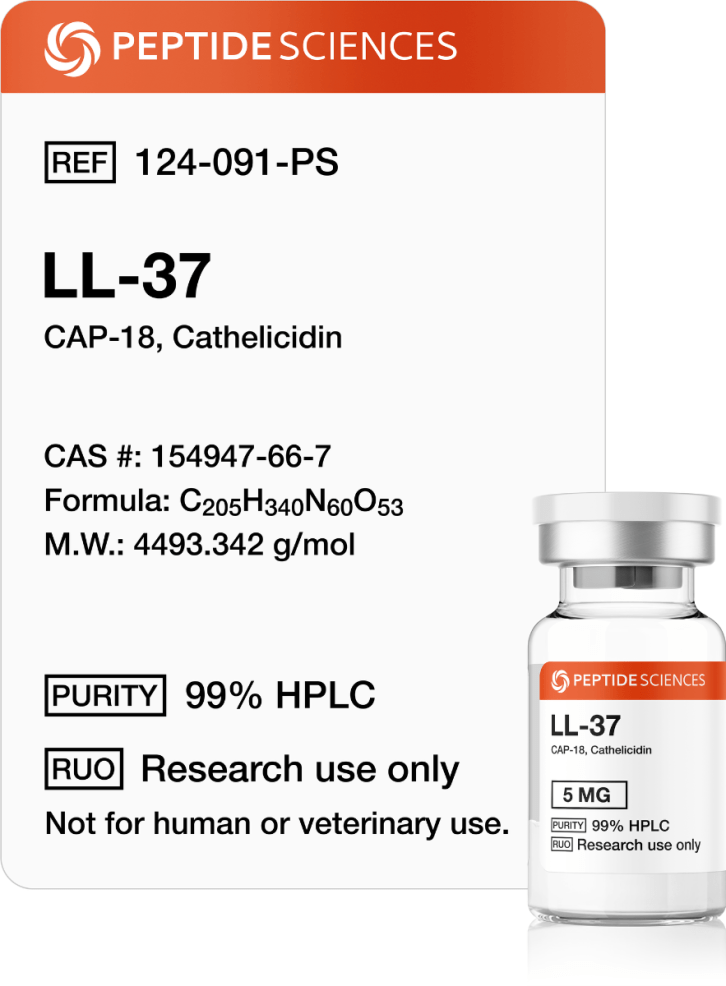
LL-37 5mg (CAP-18)
$95.00
PRODUCT SHORT DESCRIPTION
LL-37 5mg (Cathelicidin Antimicrobial Peptide / CAP-18) is a premium, high-purity synthetic 37-amino-acid cathelicidin-derived linear peptide. This 5mg formulation provides an essential biochemical tool for investigating innate immunity response, membrane permeabilization kinetics, and cellular chemotaxis pathways.
Introduction to LL-37 5mg (CAP-18)
LL-37, biochemically recognized as the functional C-terminal domain of the human Cathelicidin Antimicrobial Peptide (CAP-18), is a structurally complex, 37-amino-acid amphipathic alpha-helical peptide (Leu-Leu-Gly-Asp-Phe-Phe-Arg-Lys-Ser-Lys-Glu-Lys-Ile-Gly-Lys-Glu-Phe-Lys-Arg-Ile-Val-Gln-Arg-Ile-Lys-Asp-Phe-Leu-Arg-Asn-Leu-Val-Pro-Arg-Thr-Glu-Ser). It represents the sole member of the cathelicidin family expressed endogenously in humans, playing an indispensable role in mucosal immunology, wound response models, and systemic host defense. At USA PEPTIDE SCIENCES, we supply this premier immunomodulatory agent as a premium 5mg lyophilized matrix. This configuration provides immunology, microbiology, and regenerative medicine laboratories with a highly stable and ultra-pure baseline reagent engineered to explore cell-autonomous defenses, lipopolysaccharide (LPS) neutralization, and receptor-mediated cellular migration cascades.
Research Overview: Innate Immunity and Amphipathic Alpha-Helical Modeling
The primary investigative utility of LL-37 5mg centers on its multi-functional capacity to act simultaneously as a direct barrier molecule and a systemic cell-signaling ligand. Because its structure features a highly distinct arrangement of hydrophobic and hydrophilic residues, the peptide adopts a rigid alpha-helical conformation upon contacting lipid membranes, serving as a robust model for studying non-receptor membrane disruption alongside G-protein-coupled receptor (GPCR) activation.
Key areas of active scientific investigation utilizing LL-37 5mg (CAP-18) include:
-
Membrane Permeabilization and Lytic Kinetics: Modeling the biophysical mechanisms—such as the carpet, toroidal pore, or barrel-stave models—through which the amphipathic peptide interacts with and disrupts outer lipid bilayers in cellular simulations.
-
Lipopolysaccharide (LPS) Neutralization: Investigating the peptide’s strong binding affinity for bacterial endotoxins, specifically tracking its capacity to sequester free LPS and prevent the activation of Toll-like Receptor 4 (TLR4) pathways in inflammatory tissue lines.
-
Chemotaxis and Receptor-Ligand Dynamics: Analyzing how the peptide acts as a chemokine to recruit neutrophils, monocytes, and T-lymphocytes by engaging the Formyl Peptide Receptor-Like 1 (FPRL1/FPR2) and purinergic P2X7 receptors.
-
Angiogenesis and Tissue Repair Signaling: Evaluating downstream transcriptomic shifts related to epidermal migration, vascular endothelial growth factor (VEGF) upregulation, and structural extracellular matrix remodeling during simulated wound healing assays.
Quality Standards & Analytical Testing
At USA PEPTIDE SCIENCES, maintaining absolute data integrity and compound reproducibility is the foundation of our manufacturing operations. Every single production lot of LL-37 5mg (CAP-18) undergoes a rigid multi-tier quality control validation protocol to eliminate compounding variables and experimental artifacts. We utilize High-Performance Liquid Chromatography (HPLC) coupled with Mass Spectrometry (MS) to confirm an absolute chemical purity profile of 99% or greater. This severe analytical testing verifies the precise 37-amino-acid sequence map, molecular weight, and alpha-helical structural alignment while ensuring the total absence of residual synthesis reagents, truncated fragments, or raw contaminants. A batch-specific Certificate of Analysis (COA) accompanies every order to guarantee absolute reproducibility.
Storage and Handling Requirements
To safeguard the complex molecular bonds and prevent structural degradation of LL-37 5mg, the vacuum-sealed, lyophilized powder must be stored long-term in a freezer environment at -20°C. Prior to introducing the compound into your laboratory workflow, reconstitution must be carried out using an appropriate sterile, non-pyrogenic, or bacteriostatic diluent. Once transitioned into a liquid state, the peptide is highly sensitive to thermal breakdown and mechanical stress; reconstituted vials must be maintained under constant refrigeration at 2°C to 8°C. Researchers must dissolve the compound via a slow, gentle swirling motion, avoiding any aggressive mechanical agitation or shaking.
Research Use Disclaimer
The compounds distributed by USA PEPTIDE SCIENCES, including LL-37 5mg (CAP-18), are designated strictly for laboratory research purposes only. Under no circumstances are these products approved or intended for human or veterinary consumption, direct clinical diagnostics, or therapeutic drug administration. All handling, measuring, and experimental evaluation must be conducted exclusively by qualified scientific professionals within a certified and monitored research facility.

Reviews
Clear filtersThere are no reviews yet.