
Thymagen (Thymogen) 20mg
$80.00
PRODUCT SHORT DESCRIPTION
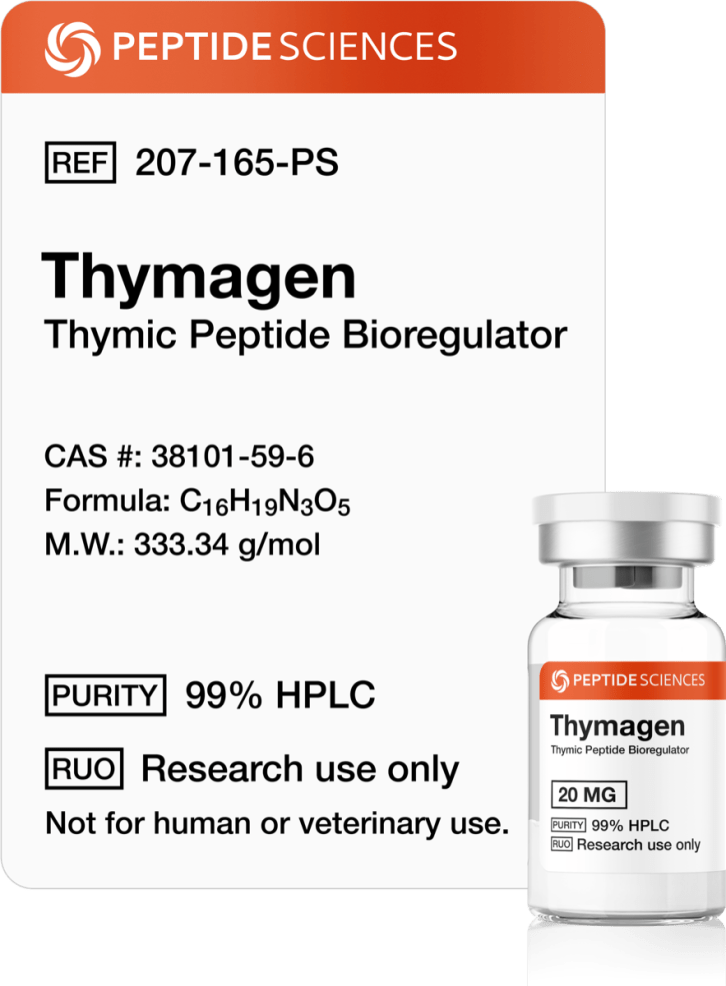
Thymagen (Thymogen) 20mg from USA PEPTIDE SCIENCES is a research-grade synthetic thymic dipeptide — glutamyl-tryptophan (Glu-Trp) — extensively investigated for its role in T-cell immunomodulation, thymic epithelial signaling, and age-related immune decline modeling. Originally developed within the Russian peptide bioregulator tradition, this well-characterized two-amino acid compound offers investigators a precise, minimal-sequence tool for studying thymic axis biology at the molecular level. Every batch is HPLC-MS verified to ≥99% purity and accompanied by a full Certificate of Analysis.
Thymagen (Thymogen) 20mg — Precision Thymic Dipeptide for Immunological Research
Introduction: Molecular Precision in Thymic Axis Research
Among the thymic peptide bioregulators that have emerged from decades of Eastern European immunological research, Thymagen (Thymogen) 20mg stands apart for its elegant molecular simplicity. Composed of just two amino acid residues — glutamic acid and tryptophan in a Glu-Trp dipeptide configuration — Thymogen represents the distilled active core of thymic signaling biology, offering investigators a structurally defined and analytically reproducible tool for studying the molecular foundations of T-cell regulation and thymic epithelial function.
First developed by the St. Petersburg Institute of Bioregulation and Gerontology under the scientific direction of Vladimir Khavinson, Thymogen has accumulated a substantive body of preclinical and translational research literature spanning immunomodulation, neuroimmune axis regulation, and biological aging research. The 20mg high-yield format from USA PEPTIDE SCIENCES is purpose-built for extended multi-phase research programs, multi-arm experimental designs, and institutional laboratory environments where compound volume and documentation consistency are equally critical.
Research Overview: Scientific Background and Investigational Applications
The deceptive simplicity of the Glu-Trp dipeptide structure belies the breadth and depth of its research profile. Thymogen’s compact sequence allows for exceptionally clean analytical characterization while providing investigators with a biologically active tool across several intersecting research disciplines.
T-Cell Immunomodulation and Thymic Signaling Research The primary focus of Thymogen’s scientific literature concerns its interactions with T-lymphocyte biology. Preclinical studies have examined its effects on thymocyte proliferation, T-cell subset differentiation, and the restoration of T-cell functional parameters in immune-deficient and aged animal models. Of particular research interest is Thymogen’s apparent capacity — documented across multiple preclinical investigations — to influence the CD4+/CD8+ T-cell ratio and support the reconstitution of more balanced immune compartment architecture in models of immune dysregulation.
Thymic Epithelial Cell Biology As a thymus-derived dipeptide bioregulator, Thymogen has been studied for its direct interactions with thymic epithelial cells — the primary cellular substrate of thymic microenvironment signaling. Research has explored its effects on thymic epithelial cell viability, cytokine secretion profiles, and the expression of thymopoietic factors including thymulin and thymopoietin analogs, providing a molecular-level research platform for investigators focused on thymic stromal biology and its role in T-cell education.
Immunosenescence and Biological Aging Models Consistent with the broader thymic peptide bioregulator research tradition, Thymogen has been prominently featured in immunosenescence studies. Age-associated thymic involution and the consequent contraction of the naïve T-cell pool represent well-established hallmarks of immune aging. Preclinical investigations have examined Thymogen’s potential to attenuate immunosenescent phenotypes in aged rodent models — exploring its effects on thymic cellularity, peripheral T-cell repertoire diversity, and NK cell functional parameters. These findings position it as a valuable reference compound in geroscience and longevity biology research programs.
Neuroimmune Axis and Stress-Immune Crosstalk Research The tryptophan residue within the Glu-Trp dipeptide introduces a dimension of neuroimmunological research relevance. Tryptophan serves as the biochemical precursor to serotonin, melatonin, and kynurenine pathway metabolites — all of which occupy significant roles in neuroimmune communication and stress-immune regulation. Preclinical research has explored Thymogen within models of stress-induced immune suppression, examining its potential interactions with HPA axis-mediated immunosuppression and corticosteroid-driven T-cell apoptosis pathways. This neuroimmune research dimension adds meaningful depth to an already multifaceted compound profile.
Antioxidant and Cytoprotective Pathway Research Thymogen has also featured in preclinical oxidative stress research, with investigators examining its interactions with antioxidant enzyme systems and free radical scavenging pathways. Studies have explored potential cytoprotective effects in models of cellular oxidative challenge, with particular attention to lymphocyte viability under pro-oxidant conditions — a research area relevant to both immunological modeling and broader cellular stress biology investigations.
Peptide Bioregulator Research Framework Thymogen occupies a foundational position within the peptide bioregulator research paradigm — a scientific framework proposing that short peptide sequences derived from specific tissues exert tissue-targeted regulatory effects through gene expression modulation. Preclinical investigations have explored Thymogen’s interactions with transcription factor binding and chromatin remodeling in lymphoid cell populations, offering investigators a unique molecular entry point into the emerging field of peptide epigenomics.
Quality Assurance & Analytical Testing
The structural simplicity of the Glu-Trp dipeptide demands an equally precise analytical approach. At USA PEPTIDE SCIENCES, every batch of Thymagen (Thymogen) 20mg is subjected to comprehensive quality verification protocols before release:
- HPLC (High-Performance Liquid Chromatography): Full chromatographic analysis confirming dipeptide purity, retention time consistency, and the complete absence of synthesis byproducts, residual coupling reagents, or degradation impurities
- Mass Spectrometry (MS): Precise molecular mass confirmation of the intact Glu-Trp dipeptide sequence, verifying structural identity and ruling out racemization, oxidation, or sequence inversion artifacts
- Amino Acid Composition Analysis: Qualitative verification of both glutamic acid and tryptophan residues within the correct dipeptide linkage configuration
- Endotoxin and Sterility Screening: Applied to all production batches to meet the contamination control standards required in professional preclinical research environments
Each 20mg unit is released only upon confirmation of ≥99% purity, with a fully traceable Certificate of Analysis (COA) available through the USA PEPTIDE SCIENCES documentation platform. The COA provides complete analytical traceability from synthesis through final release testing — essential for institutional compliance, grant documentation, and publication-grade experimental reproducibility.
Lyophilization is conducted under controlled pharmaceutical-grade conditions, preserving the chemical integrity and stability of the dipeptide through packaging, transit, and laboratory reconstitution.
Storage & Handling Recommendations for Laboratory Use
The dipeptide structure of Thymogen, while analytically straightforward, requires conscientious storage and handling to maintain experimental reliability across multi-phase research timelines.
Recommended storage conditions:
- Long-term archival storage: −20°C in a sealed, desiccated, light-protected environment; stable for up to 24 months under optimal conditions
- Active working storage: 2–8°C, protected from light and humidity, for short-term use following initial compound access
- Post-reconstitution: Reconstitute using sterile bacteriostatic water or an appropriate research-grade aqueous solvent at the concentration required by your experimental protocol; store reconstituted aliquots at 2–8°C and use within a timeframe consistent with current dipeptide stability recommendations
- Pre-aliquot into single-use portions prior to archival storage to eliminate repeated freeze-thaw cycling and protect batch integrity across extended study timelines
- Handle under sterile laboratory conditions using appropriate PPE and in full compliance with institutional biosafety and compound handling regulations
Research Use Disclaimer
Thymagen (Thymogen) 20mg supplied by USA PEPTIDE SCIENCES is intended exclusively for in vitro research and preclinical laboratory investigation. This compound has not been approved by the U.S. Food and Drug Administration or any equivalent international regulatory authority for administration to humans or animals outside of formally authorized research contexts.
This product is not a pharmaceutical, dietary supplement, or therapeutic preparation of any kind. It is not intended to diagnose, treat, cure, or prevent any disease or medical condition, and must not be self-administered or applied to human subjects outside of a properly licensed, ethically approved, and institutionally supervised research environment.
By completing a purchase, the acquiring party confirms they are a qualified scientific professional procuring this compound solely for lawful research purposes in full compliance with all applicable federal, state, and local regulations.
USA PEPTIDE SCIENCES remains dedicated to empowering the global research community with analytically verified, fully documented, and rigorously manufactured compounds — because science built on reliable sourcing is science built to last.
Reviews
Clear filtersThere are no reviews yet.