
Gut Inflammation (60 Capsules) (Stable BPC-157, KPV, PEA, Tributyrin)
$325.00
PRODUCT SHORT DESCRIPTION
The Gut Inflammation research platform delivers an integrated, multi-pathway laboratory formulation containing 60 capsules, each precisely dosed with 500mcg Stable BPC-157 Arginate, 500mcg KPV, 400mg Palmitoylethanolamide (PEA), and 400mg Tributyrin. This specialized configuration is engineered strictly for investigating gastric juice stability, tight-junction regulation, and synergistic mucosal lining repair cascades in vitro.
Introduction to the Gastrointestinal Multi-Pathway Matrix
The Gut Inflammation (60 Capsules) research matrix represents a highly advanced, multi-mechanistic oral-delivery platform designed to evaluate compound synergy along the mammalian gastrointestinal epithelium and mucosal barrier. Rather than relying on a single isolated pathway, this formulation integrates two highly stable synthetic peptides—BPC-157 Arginate Salt and KPV—with two lipid-derived homeostatic modulators, Palmitoylethanolamide (PEA) and Tributyrin. At USA PEPTIDE SCIENCES, we supply this complex baseline matrix in a standardized 60-capsule evaluation kit. This configuration provides gastroenterology, immunology, and molecular biology laboratories with a resilient, highly bioavailable vehicle to map localized cytokine suppression, cellular junction restoration, and non-competitive neuro-immune receptor cross-talk.
Research Overview: Four-Tiered Epithelial Synergy
The primary scientific value of the Gut Inflammation matrix centers on its multi-tiered approach to halting inflammatory cascades within compromised tissue lines. By targeting parallel structural and immunological vectors, the blend allows researchers to track precise, steady-state data regarding structural cell-autonomous recovery.
Key areas of active scientific investigation utilizing this combined research platform include:
-
Gastric Acid Stability and Enhanced Bioavailability: Modeling the structural resilience of BPC-157 Arginate Salt. By pairing the synthetic pentadecapeptide with an L-Arginine protective buffer, the compound exhibits an exceptional oral bioavailability profile exceeding 90%. In vitro simulations show a mere 5% degradation after a 5-hour incubation window in simulated gastric acid ($\text{HCl}$ / pepsin matrices), compared to the rapid 98% breakdown observed in standard BPC-157 variations.
-
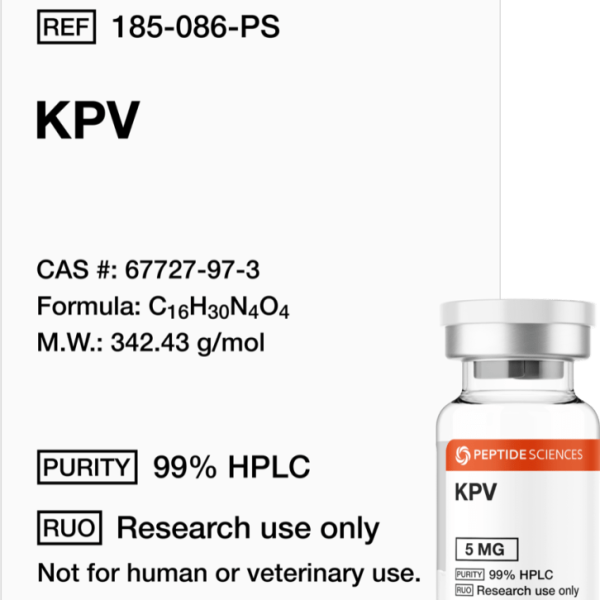
NF-$\kappa$B Inhibition and Cytokine Suppression: Tracking the intracellular signaling loops mediated by the tripeptide KPV ($\text{Lys-Pro-Val}$). Researchers examine how KPV blocks the nuclear translocation of Nuclear Factor kappa B (NF-$\kappa$B) in both intestinal epithelial cells and active immune cells, subsequently shutting down the transcription and downstream secretion of damaging pro-inflammatory cytokines such as TNF-$\alpha$, IL-1$\beta$, and IL-6.
-
Neuro-Immune Receptor Cross-Talk and Pain Modulation: Analyzing the dual anti-nociceptive and anti-inflammatory properties of Palmitoylethanolamide (PEA). As a fatty acid amide, PEA interacts with the peroxisome proliferator-activated receptor alpha (PPAR-$\alpha$) and G-protein coupled receptors to down-regulate mast cell activation, offering an advanced model for studying the mitigation of visceral pain and chronic neuro-inflammatory signaling along the enteric nervous system.
-
Tight-Junction Regulation and Barrier Consolidation: Evaluating the structural impacts of Tributyrin, a natural butyrate pro-drug triglyceride. Research focuses on its ability to upregulate the expression of vital tight-junction proteins (such as claudins, occludins, and zonula occludens-1), thereby minimizing luminal permeability while simultaneously boosting local mucus synthesis and stimulating vitamin D3 receptor expression.
Combined Mechanisms of Inflammatory Mitigation
When introduced into compromised gastrointestinal cell lines, the components of this research matrix operate synergistically to regulate inflammatory baselines via overlapping biomolecular pathways:
-
Cyclooxygenase-2 (COX-2) Down-Regulation: Observing the joint capacity of BPC-157 and PEA to decrease the synthesis of arachidonic acid metabolites and downstream inflammatory eicosanoids.
-
Systemic TNF-$\alpha$ Reduction: Mapping out the combined transcriptional blockage that significantly lowers tumor necrosis factor-alpha concentrations within systemic tissue assays.
-
Nuclear Transcription Factor Activation: Tracking the stimulation of native, cell-autonomous cytoprotective loops and anti-oxidant responses responsible for re-establishing immune homeostasis.
-
Mucosal Layer Optimization: Quantifying improvements in localized gastric mucous secretion thickness and cellular composition to isolate the triggers of wound healing in severe ulcer or colitis models.
Quality Standards & Analytical Testing
At USA PEPTIDE SCIENCES, laboratory data integrity and compound reproducibility are the fundamental core of our manufacturing operations. Every single batch of the Gut Inflammation (60 Capsules) blend undergoes severe analytical validation to eliminate compounding variables and experimental artifacts. We utilize High-Performance Liquid Chromatography (HPLC) coupled with Mass Spectrometry (MS) to confirm an absolute chemical purity profile of 99% or greater for the peptide components, alongside strict gas chromatography or nuclear magnetic resonance (NMR) validation for the integrated lipids and triglycerides. This rigorous testing verifies exact molecular weights, proper structural salification, and sequence maps while ensuring the total absence of residual synthesis reagents or contaminants. A batch-specific Certificate of Analysis (COA) accompanies every order.
Storage and Handling Requirements
To safeguard the delicate peptide bonds, lipid structures, and ester linkages from premature degradation, the Gut Inflammation evaluation kit must be stored long-term in a cool, dark, climate-controlled environment, ideally at a constant temperature profile between 2°C and 8°C. The capsules must remain completely sealed within their original container to prevent ambient moisture contamination or oxidative stress. Prior to introducing the material into analytical testing arrays or cellular culture preparations, researchers must allow the container to reach ambient room temperature to prevent condensation formation on the matrix structures.
Research Use Disclaimer
The compounds distributed by USA PEPTIDE SCIENCES, including the Gut Inflammation 60 Capsules research blend, are designated strictly for laboratory research purposes only. Under no circumstances are these products approved or intended for human or veterinary consumption, direct clinical diagnostics, or therapeutic drug administration. All handling, measuring, and experimental evaluation must be conducted exclusively by qualified scientific professionals within a certified and monitored research facility.
Reviews
Clear filtersThere are no reviews yet.