
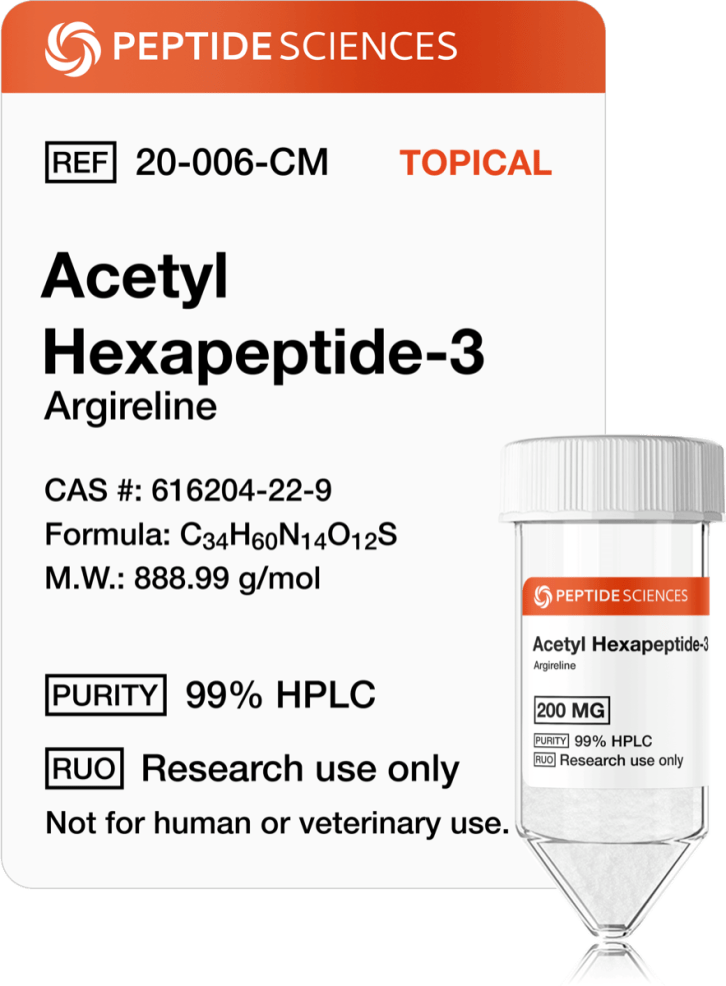
Acetyl Hexapeptide-3 (Argireline) 200mg (Topical)
$220.00
PRODUCT SHORT DESCRIPTION
Acetyl Hexapeptide-3 (Argireline) 200mg is a premium, high-purity synthetic topical research peptide engineered for advanced cutaneous neuro-transmission, SNARE protein complex interference, and dermal matrix architecture investigations. This high-concentration 200mg configuration provides an exceptionally precise biochemical tool for mapping localized muscular relaxation and anti-wrinkle kinetics.
Introduction to Acetyl Hexapeptide-3 200mg (Argireline)
Acetyl Hexapeptide-3, commercially and scientifically referred to as Argireline ($\text{Ac-Glu-Glu-Met-Gln-Arg-Arg-NH}_2$), is a synthetically derived peptide analogue patterned after the N-terminal end of the synaptosomal-associated protein 25 ($\text{SNAP-25}$). It is engineered for high-resolution topical, cosmetic chemistry, and neuromuscular junction research models. As a specialized molecular probe, Acetyl Hexapeptide-3 serves as a non-toxic alternative to botulinum neurotoxins, developed specifically to evaluate localized muscle relaxation, vesicle docking kinetics, and epidermal structural resilience within mammalian skin interfaces.
Because large macro-proteins and native neurotoxins present substantial molecular weights that face massive transport barriers or severe safety handling constraints in laboratory workflows, Acetyl Hexapeptide-3’s streamlined 6-amino-acid sequence provides an optimal, highly manageable candidate for tracking cell-autonomous signaling pathways. At USA PEPTIDE SCIENCES, we supply this high-concentration configuration as a vacuum-sealed, lyophilized 200mg vial, providing dermatology, molecular biology, and neurology research institutions with an ultra-pure, standardized baseline reagent to map neurotransmitter inhibition curves and structural tissue-remodeling metrics.
Research Overview: SNARE Complex Interference and Neuromuscular Mechanics
The primary scientific value of Acetyl Hexapeptide-3 200mg centers on its capacity to mimic a critical segment of the $\text{SNAP-25}$ protein, thereby destabilizing the core apparatus required for cell-to-cell chemical communication. By focusing on non-systemic, localized interfaces, this hexapeptide allows researchers to analyze structural cellular dynamics and muscle-attenuation kinetics under controlled laboratory conditions.
Key areas of active scientific investigation utilizing Acetyl Hexapeptide-3 200mg include:
-
SNARE Protein Complex Destabilization: Modeling the competitive inhibition of vesicle docking. For a cell to release neurotransmitters, it must form a stable soluble N-ethylmaleimide-sensitive factor attachment protein receptor ($\text{SNARE}$) complex, which bridges the vesicle to the cellular membrane. Acetyl Hexapeptide-3 competes with native $\text{SNAP-25}$ for a position in this tertiary complex. By displacing the native protein, the peptide introduces conformational instability, rendering the complex incapable of driving efficient membrane fusion.
-
Inhibition of Acetylcholine (ACh) Release: Investigating the down-regulation of exocytosis pathways. When the neuromuscular junction is unable to form a functional $\text{SNARE}$ setup, the calcium-dependent docking and subsequent fusion of acetylcholine-filled vesicles are significantly disrupted. Researchers track this blockade to quantify reductions in localized $\text{ACh}$ release, mapping the subsequent decrease in muscle fiber contraction velocity.
-
Cutaneous Tensile Relief and Anti-Wrinkle Kinetics: Analyzing the mitigation of mechanical skin stress. Persistent micro-contractions of facial and subcutaneous muscles are a primary engine behind dermal creasing and structural degradation over time. Investigators utilize topical applications of Acetyl Hexapeptide-3 to evaluate the relaxation of these localized tension zones, monitoring changes in overall skin depth, smoothness, and structural alignment in animal and tissue-culture matrices.
-
Extracellular Matrix (ECM) Protection and Fibroblast Health: Evaluating secondary dermal architectural stability. Beyond its prominent status in muscle-attenuation profiles, research models focus on how relieving mechanical stress influences native collagen synthesis lines. Studies examine if the reduction of continuous mechanical shearing preserves local fibroblast morphology and down-regulates matrix metalloproteinases ($\text{MMPs}$) responsible for the premature degradation of Type I collagen networks.
Quality Standards & Analytical Testing
At USA PEPTIDE SCIENCES, laboratory data integrity and compound reproducibility are the fundamental core of our manufacturing operations. Every single production lot of Acetyl Hexapeptide-3 200mg (Topical) undergoes a severe quality control validation protocol to eliminate compounding variables and experimental artifacts. We utilize High-Performance Liquid Chromatography (HPLC) coupled with Mass Spectrometry (MS) to confirm an absolute chemical purity profile of 99% or greater. This rigorous analytical validation verifies the exact hexapeptide sequence layout, precise molecular weight, and correct spatial conformation while ensuring the total absence of residual synthesis reagents, truncated fragments, heavy metals, or raw contaminants. A batch-specific Certificate of Analysis (COA) accompanies every order to guarantee absolute reproducibility.
Storage and Handling Requirements
To safeguard the delicate peptide bonds and prevent premature structural degradation of the 200mg lyophilized cake, all vials must be stored long-term in a freezer environment at -20°C, completely shielded from light and ambient moisture. Prior to introducing the compound into your laboratory workflow, reconstitution must be carried out using an appropriate sterile, non-pyrogenic, or bacteriostatic diluent optimized for topical or localized cellular applications. Once transitioned into a liquid state, the peptide solution becomes highly sensitive to thermal breakdown and mechanical stress; reconstituted vials must be maintained under constant refrigeration at 2°C to 8°C. Researchers must dissolve the compound via a slow, gentle swirling motion, avoiding any aggressive mechanical agitation, inversion, or shaking.
Research Use Disclaimer
The compounds distributed by USA PEPTIDE SCIENCES, including Acetyl Hexapeptide-3 200mg research vials, are designated strictly for laboratory research purposes only. Under no circumstances are these products approved or intended for human or veterinary consumption, direct clinical diagnostics, or therapeutic drug administration. All handling, measuring, and experimental evaluation must be conducted exclusively by qualified scientific professionals within a certified and monitored research facility.
Reviews
Clear filtersThere are no reviews yet.