
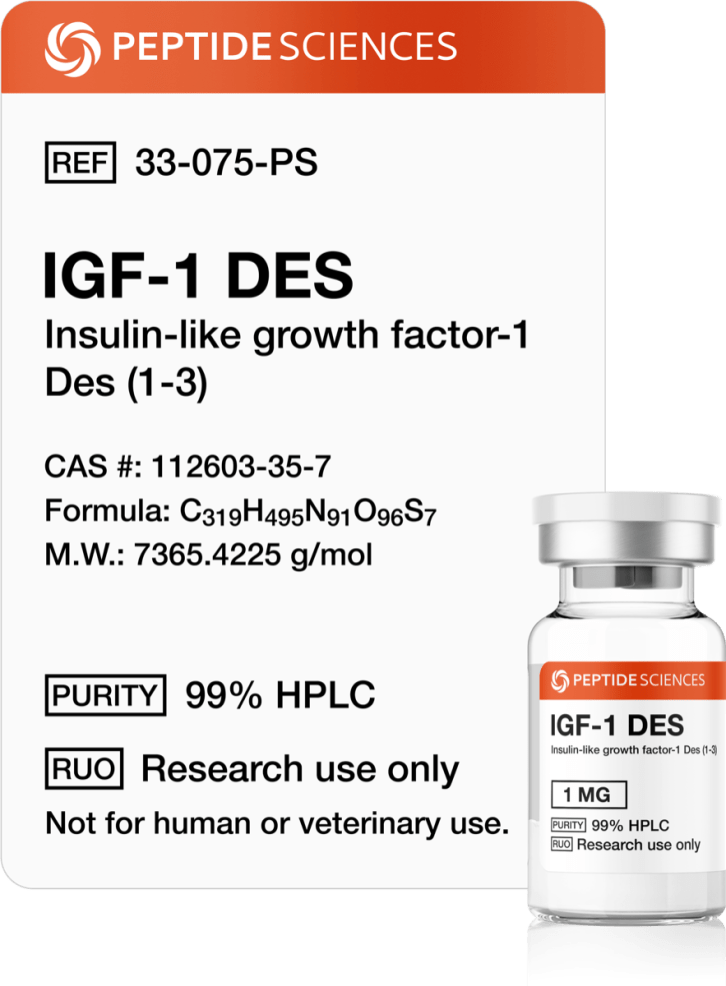
IGF-1 DES 1mg
$110.00
PRODUCT SHORT DESCRIPTION
IGF-1 DES 1mg is a premium, high-purity synthetic 67-amino-acid truncated variant of Insulin-like Growth Factor-1. This 1000mcg configuration provides an isolated biochemical tool for investigating localized receptor binding kinetics, rapid hypertrophy pathways, and cellular repair mechanics under conditions of altered binding protein availability.
Introduction to IGF-1 DES 1mg
IGF-1 DES, biochemically classified as des(1-3)IGF-1, is a naturally occurring, truncated splice variant of human Insulin-like Growth Factor-1 synthesized for high-resolution studies in molecular biology, neurogenesis, and cellular hypertrophy. Composed of a 67-amino-acid single-chain polypeptide, its structure is defined by the precise deletion of the tripeptide sequence Glycine-Proline-Glutamate from the N-terminus ($\text{des[1-3]}$). This structural truncation alters its molecular configuration compared to full-length IGF-1. At USA PEPTIDE SCIENCES, we supply this advanced growth factor variant as a premium 1mg lyophilized cake, providing pharmacology, neurology, and regenerative medicine laboratories with a highly stable and ultra-pure matrix to analyze localized cell-signaling kinetics without the confounding variables introduced by systemic binding inhibitors.
Research Overview: Truncation Kinetics and Receptor Hyper-Activation
The primary scientific value of IGF-1 DES 1mg centers on its altered binding mechanics. In native cellular models, full-length IGF-1 is heavily regulated by a family of six circulating Insulin-like Growth Factor-Binding Proteins (IGFBPs) that sequester the molecule, creating a biological buffer that dampens immediate receptor interaction.
Key areas of active scientific investigation utilizing IGF-1 DES 1mg include:
-
IGFBP Evasion Dynamics: Modeling the structural alterations caused by the missing N-terminal tripeptide domain. Because this deleted region is critical for binding protein recognition, IGF-1 DES exhibits nearly complete evasion of IGFBPs, resulting in dramatically higher levels of free, unbound ligand in cellular media assays.
-
IGF-1R Binding Optimization: Tracking the peptide’s direct affinity for the Insulin-like Growth Factor 1 Receptor (IGF-1R). Uninhibited by binding proteins, it interacts with cellular receptors at an elevated baseline rate, serving as a model for studying rapid, localized signal transduction.
-
Hypertrophic and Mitogenic Signaling: Investigating downstream intracellular signaling cascades—specifically the PI3K/Akt/mTOR and MAPK/ERK pathways—that govern protein synthesis, cellular proliferation, satellite cell activation, and microvascular tissue repair.
-
Neurological Homeostasis and Synaptic Plasticity: Evaluating the truncated factor’s capacity to cross blood-brain barrier models and interact with neural substrates, supporting investigations into neurodegenerative modulation, axon regeneration, and synaptic density enhancements under stress models.
Quality Standards & Analytical Testing
At USA PEPTIDE SCIENCES, maintaining absolute data integrity and compound reproducibility is the foundation of our manufacturing operations. Every single production lot of IGF-1 DES 1mg undergoes a rigid multi-tier quality control validation protocol to eliminate compounding variables and experimental artifacts. We utilize High-Performance Liquid Chromatography (HPLC) coupled with Mass Spectrometry (MS) to confirm an absolute chemical purity profile of 99% or greater. This severe analytical confirmation verifies the exact 67-amino-acid truncated map, correct disulfide bridge configuration, and precise molecular mass while ensuring the total absence of residual synthesis reagents, truncated fragments, or raw contaminants. A batch-specific Certificate of Analysis (COA) accompanies every order to guarantee absolute reproducibility.
Storage and Handling Requirements
To preserve the complex tertiary structure and prevent denaturation of IGF-1 DES 1mg, the vacuum-sealed, lyophilized powder must be stored long-term in a freezer environment at -20°C. Prior to introducing the compound into your laboratory workflow, reconstitution must be carried out using an appropriate sterile, non-pyrogenic, or slightly acidic solution (such as diluted acetic acid or sterile water) optimized for complex polypeptide stability. Once transitioned into a liquid state, the growth factor is highly sensitive to thermal breakdown and mechanical shear stress; reconstituted vials must be maintained under constant refrigeration at 2°C to 8°C. Researchers must dissolve the compound via a slow, gentle swirling motion, avoiding any aggressive mechanical agitation, inversion, or shaking.
Research Use Disclaimer
The compounds distributed by USA PEPTIDE SCIENCES, including IGF-1 DES 1mg, are designated strictly for laboratory research purposes only. Under no circumstances are these products approved or intended for human or veterinary consumption, direct clinical diagnostics, or therapeutic drug administration. All handling, measuring, and experimental evaluation must be conducted exclusively by qualified scientific professionals within a certified and monitored research facility.
Reviews
Clear filtersThere are no reviews yet.